The Fairway That Used to Be a Finish Line
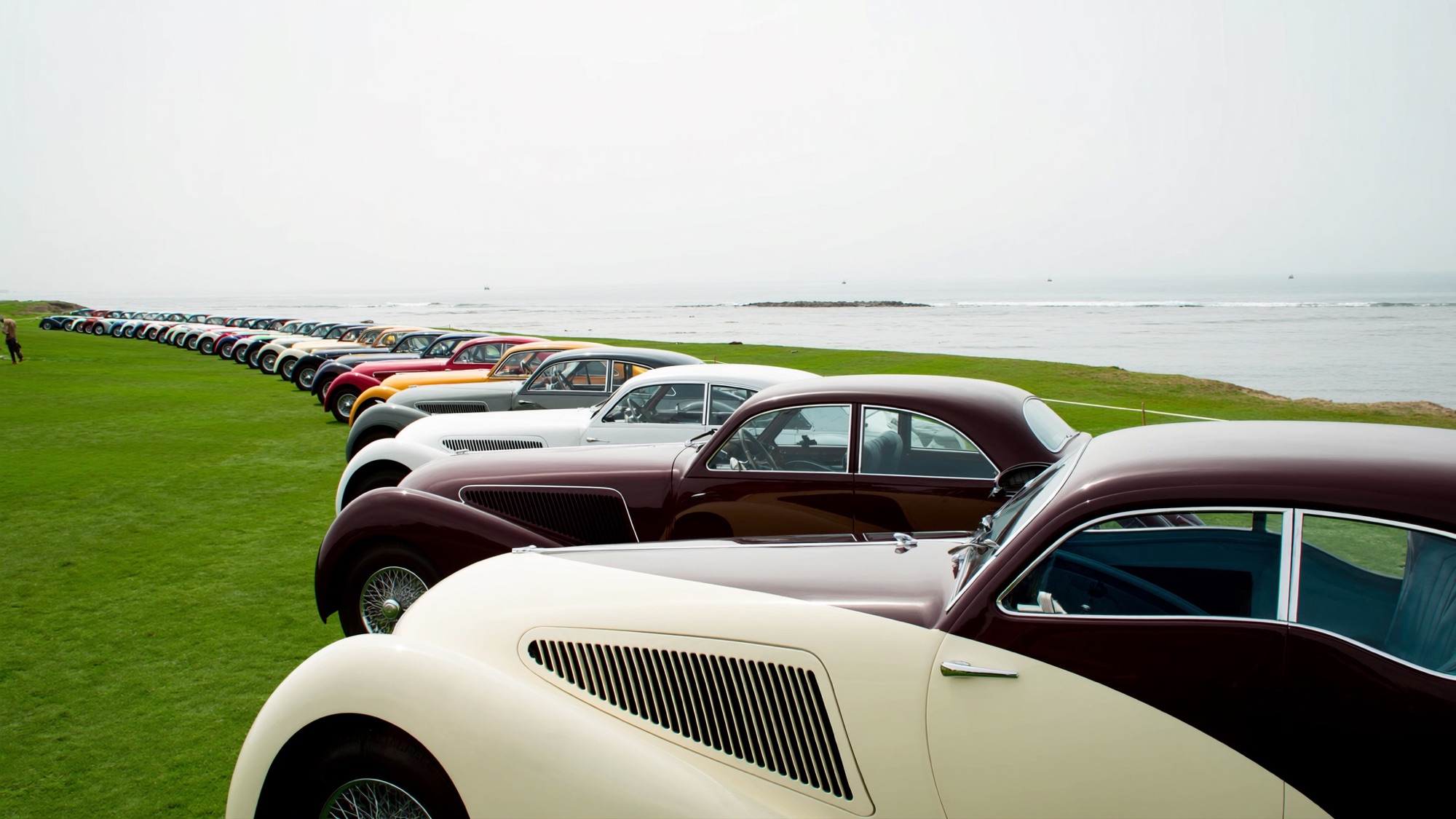
On the morning of August 16, 2026, the 18th fairway of Pebble Beach Golf Links will close to golf, as it has every August for seventy-four years before this one, and roughly two hundred cars will be arranged on the grass between the Lodge and the Pacific. Judges in blazers will walk the field with clipboards. A crowd that has paid up to $650 a head will stand at rope lines. Late in the afternoon, one car will be driven forward, alone, to a low stage, and the largest title in the automobile world will be conferred on it: Best of Show.
This is the 75th Pebble Beach Concours d’Elegance, and it did not begin as the main event. It began as the warm-up act for something faster and considerably more dangerous — a road race through a forest, run on public streets, that killed a man and no longer exists. The concours outlived the thing it was invented to accompany. That inversion is the whole story.
What Actually Happened in 1950
The first Pebble Beach Concours d’Elegance was staged on November 4, 1950, not in August and not on the 18th fairway. Thirty cars were shown on a practice tee and driving range near the Beach Club, close to the Del Monte Lodge. It was a secondary attraction, added to give some polish to the main event of the weekend: the inaugural Pebble Beach Road Race, run the next day on 1.8 miles of closed public roads through the Del Monte Forest and organized under the Sports Car Club of America. Phil Hill won that first race in a Jaguar XK120, after starting from behind with clutch trouble. Judges at the adjoining concours picked a 1950 Edwards R-26 Special Sport Roadster, built and shown by Sterling Edwards, as the first Best of Show winner.
For the next seven years, the road race was the draw. Crowds that reportedly ran as high as 50,000 lined a course that grew to 2.1 twisting miles through the trees, watching sports cars go through corners that had been designed for delivery trucks, not competition machinery. The concours ran alongside it each year, a smaller and gentler counter-program: cars parked rather than cars driven at speed.
In 1952, the concours moved to its permanent home — the 18th green of the Pebble Beach Golf Links, framed by the Lodge on one side and Carmel Bay on the other. The larger, more photogenic setting drew more entries and more spectators, and the show began to grow in a way the road race, hemmed in by residential streets and hay bales, structurally could not.
The Race That Ended, and the One That Didn’t
The road race’s final edition ran in 1956. During that event, driver Ernie McAfee misjudged the entry to the sixth turn, clipped a hay bale, and went off the course broadside into a tree in his Ferrari. He was killed instantly. The crash ended the Pebble Beach Road Races outright — a public-road circuit through a residential forest was never going to survive a fatality of that kind in an era when motorsport safety was catching up to motorsport speed. Organizers spent the winter of 1956–57 arranging a parcel of government land roughly five miles away for a permanent, purpose-built circuit. It opened in 1957 as Laguna Seca Raceway, which still hosts major racing today.
The concours did not go with it. It had already established its own gravity — its own site, its own growing prestige, its own audience that had come to see cars standing still and judged rather than cars moving fast and crashing. What had been the secondary event outlasted the primary one by seventy years and counting.
The 75th-edition numbering itself tells a small, precise story about that continuity. The concours has run every year since 1950 except two: 1960, cancelled over a scheduling conflict, and 2020, cancelled to the pandemic, with what would have been the 70th event deferred to 2021. Seventy-seven calendar years minus those two absences gets you to exactly 75 in 2026 — an anniversary number that is not rounded or approximate, but the literal count of years the judges have actually stood on that lawn.
How Judging Actually Works
The show field is not a display; it is a competition with a scoring system as exacting as any in sport. Class Judges assess each car on authenticity, the quality of its restoration or preservation, its beauty, its technical execution, and its documented history. Class winners then go before a smaller panel — the Chief Class Judges, Honorary Team Leaders, the Chief Judge, the Chairman, and the Chief Honorary Judge — who select among them. The most recent judging corps at Pebble Beach carried a combined total of more than 2,200 years of judging experience between them, which is either an absurd statistic or a fair description of how narrow and specialized this expertise actually is.
Best of Show is picked from the class winners in front of the crowd late in the afternoon, announced amid confetti and popped corks, and comes with an engraved trophy and an engraved Rolex — the brand has been the concours’ official timekeeper and Best of Show gift-giver since 1997.
There is also a driving test built into the judging now. The Tour d’Elegance, a roughly 70-mile road route through the Monterey Peninsula run two days before the show, was introduced in 1998 specifically to answer a criticism that had dogged the concours for decades: that its cars were too rarely driven, kept as static objects rather than the machines they were built to be. Roughly seventy cars — about a third of the field — ran the first Tour. Today around 80 percent of entrants complete it, and a green ribbon awarded to finishers can break ties in class judging. A car with a Rolex-caliber restoration that cannot also survive seventy miles of Highway 1 is, in the culture this event has built, an incomplete car.
The Entry Is the Competition
Here is the detail that separates Pebble Beach from every other car event on the calendar, including the auctions that surround it that same week: you cannot buy your way onto the lawn.
Entry applications go out each November, and are due back in early January. A Selection Committee — automotive historians and specialists, not sales staff — spends February vetting them: provenance, condition, history, and whether the car has appeared too recently at Pebble Beach or another major concours. As a rule, a car generally cannot return within ten years of a prior showing, unless it has changed hands and been freshly restored, or is being shown as an original, unrestored preservation piece. Most applicants hear back in April. Cars that are accepted are then barred from appearing at any other public show, display, or auction that August before the concours itself — the field has to be, in a real sense, exclusive to Pebble Beach that week.
There is no price of admission for a car. There is a jury.
That is the mechanism worth sitting with. A spectator ticket is a transaction: $550 today, rising to $650 on August 1, 2026, according to the concours’ own ticket office — plus significantly more for the Concours Gallery, Club d’Elegance, Patrons Patio, and Chairman’s Hospitality tiers that sit above general admission. Anyone with the money and a working credit card can watch. But the two hundred cars on the grass are there because a committee of specialists decided, competitively, that they deserved to be — against a field of other cars whose owners also believe theirs belongs there, and who were told no.
The 75th Edition’s Field
This year’s honored marque is Ferrari, with particular attention paid to the marque’s Le Mans-winning and NART competition history; more than 900 Ferraris have appeared at Pebble Beach since the marque’s own debut there in 1951, when Jim Kimberly — heir to the Kimberly-Clark paper fortune — showed his 1949 166 MM Touring Barchetta. The featured coachbuilder is Carrozzeria Alfredo Vignale, the Italian house that bodied Ferraris, Lancias, Fiats, and Maseratis through the 1950s in a style the concours itself has described as the coachbuilt embodiment of la dolce vita.
Four new or revived classes mark the anniversary. Early American Speedsters (Pre-WWI) brings out minimalist, high-horsepower machines like the Mercer Raceabout and Stutz Bearcat — cars built with almost nothing on them beyond an engine and two seats, the most literal ancestors of everything that will be judged around them. Classic Streamliners assembles the aerodynamic experiments of the 1930s: sloping grilles, fastback tails, the first era in which car design borrowed openly from aviation. Pebble Beach Road Racing Greats brings the story back to where it started, honoring cars connected to the 1950–56 races directly. And Japanese Motorsports: The Rising Sun at Speed gathers Le Mans-class competition cars from Toyota, Mazda, Nissan, and Honda — a category that would have been unthinkable at the 1950 show and says something about how far the definition of “significant automobile” has moved in seventy-five years.
What the Lawn Actually Sells
It would be easy to write the Pebble Beach Concours as a story about money — the most expensive cars in the world, on the most expensive real estate on the California coast, watched by people who paid several hundred dollars to look. That story isn’t wrong, but it isn’t the interesting one, and it isn’t the one the event itself is telling.
The interesting story is that Pebble Beach solved, seventy-five years ago and without particularly meaning to, the exact problem every serious membership organization eventually has to solve: how do you keep access meaningful once the people who want in can all afford it? The answer here is the same answer LXV was built on. You do not sell the good seat. You build a jury, you make the jury genuinely expert, and you let scarcity be a function of judgment rather than of price. A ticket buys a look. An invitation — vetted, timed, revocable, earned against other serious claimants — buys the thing itself. Ernie McAfee’s road race is gone because roads are dangerous. The concours that used to open for him is still here, seventy-five years on, because it figured out how to be a club instead of a show.