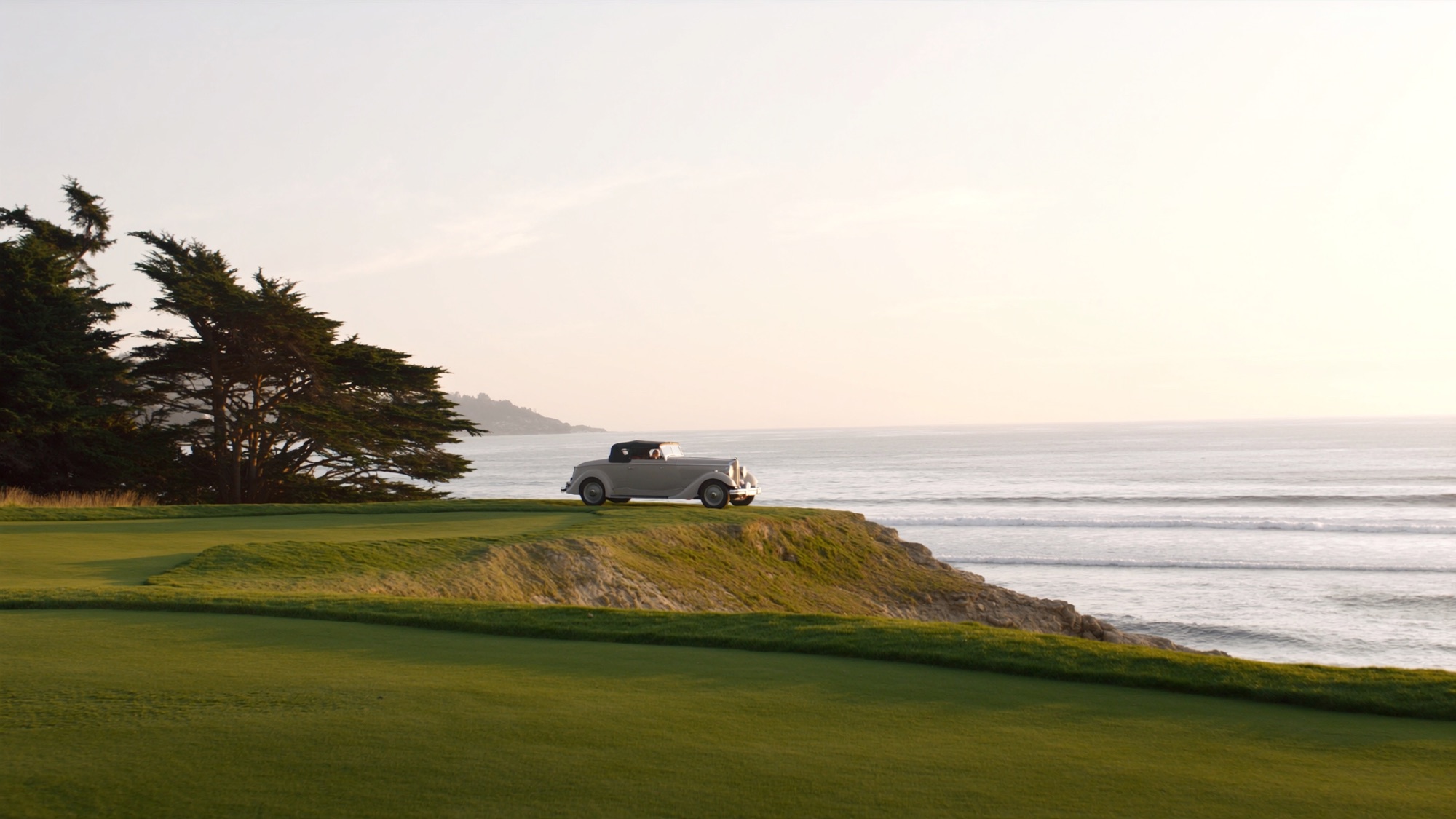
The Ticket Is Not the Hard Part
On August 16, 2026, the 75th Pebble Beach Concours d’Elegance will stage roughly 200 cars on the 18th fairway of Pebble Beach Golf Links, closing out ten days of racing, auctions, and marque gatherings that run under the umbrella name Monterey Car Week. A Concours ticket, bought through the official store, is available to anyone who wants one. It is not the hard part.
The hard part is everything adjacent to it. A room at the Lodge that week. A tee time on a course within twenty minutes of Highway 1. A dinner reservation. A seat at one of the events happening on private land that never appears in a public calendar at all. Car Week is built, physically, on top of the densest concentration of elite private golf in the United States — Cypress Point, Monterey Peninsula Country Club, the Santa Lucia Preserve, Pebble Beach itself — and for one week a year, the two worlds’ guest lists become almost impossible to tell apart.
That is close to the whole story.
A Golf Course Hosting a Car Show
Start with the plainest fact, which is stranger the longer you sit with it: the marquee event of American car culture is not held in a stadium, a convention center, or a closed street circuit. It is held on a golf course. The Pebble Beach Concours d’Elegance has run on the 18th fairway of Pebble Beach Golf Links every August since 1950, and this year’s edition — the 75th — closes the week on Sunday, having grown from a small gathering tied to the old Pebble Beach Road Race into the auction and exhibition event that now anchors ten days of activity across the peninsula. Pebble Beach Company, which owns the golf course the cars sit on, also owns the Lodge at Pebble Beach, the Inn at Spanish Bay, Casa Palmero, Spyglass Hill Golf Course, and Del Monte Golf Course — a great deal of the peninsula’s Car Week infrastructure, lodging and golf alike, running through a single private landlord with a golf-course-shaped centerpiece to protect.
For one Sunday, a working championship golf course — the same fairway members and $695-green-fee guests play the other 364 days of the year — closes to golf entirely and becomes an outdoor concourse. The rope lines, the judging classes, the Ferrari-and-Vignale feature marques announced for 2026: all of it happens on turf. Car Week’s center of gravity is a golf hole. Everything else radiates outward from it.
Cypress Point: The Club That Doesn’t Take Applications
Six minutes from that 18th fairway sits the club most golfers will never see the inside of. Cypress Point Club opened for play on August 11, 1928, designed by Alister MacKenzie with Robert Hunter, and has spent the century since being called — by people whose job it is to rank these things — among the two or three best golf courses on earth. Golf Digest’s most recent ranking places it third in the country; Top100GolfCourses.com has it first.
None of that is the reason it belongs here. The reason is that Cypress Point has, by widely repeated report, roughly 250 members, no public website, and no published tee sheet — membership moves by invitation and sponsorship from within, not application. Initiation costs are reported by golf-industry trade press at anywhere from roughly $250,000 to $500,000, a spread wide enough to read as evidence of how little is actually confirmed; LXV is hedging it here rather than reporting it as fact. What is verifiable is simpler: during the one week the world’s attention turns toward this stretch of coastline, the club that owns arguably its best golf course does not open its doors, sell a ticket, or issue a statement. It continues not existing publicly, which during Car Week is its own kind of statement.
Monterey Peninsula Country Club — Two Courses, One Long Membership List
A short drive north, Monterey Peninsula Country Club runs two courses on roughly 400 acres: the Dunes, opened in 1926 and originally laid out by Seth Raynor before Alister MacKenzie and Robert Hunter finished construction after Raynor’s death, and the Shore, built in 1959–1960 and substantially reworked by Mike Strantz in a 2003–2004 reconstruction. The club received its charter with 68 founding members on February 19, 1925, with Samuel F. B. Morse — the developer behind Pebble Beach itself — as its first president. The Shore Course has rotated into the AT&T Pebble Beach Pro-Am field since 2010.
MPCC is private and member-sponsored, and its current roster size and initiation figures are not published anywhere LXV could verify — a gap worth flagging rather than filling with a guess. What is verifiable is the structural point: MPCC’s membership overlaps heavily, by reputation, with the same collector, executive, and old-money Northern California families who show up in the Concours paddock each August. The club does not need to host a Car Week event to be part of Car Week. Its membership already is.
Pebble Beach Golf Links: Public in Name, Rationed in Practice
Pebble Beach Golf Links is the one course on this list anyone can, in theory, play — it has been open to the public since 1919, no membership required. In practice, August access is rationed by three separate mechanisms that all tighten around Car Week.
First, price: the 2026 green fee is $695 per player, plus a $60 cart fee, or a caddie at $155 to $210 depending on bag count. Second, priority: guests staying at the Lodge at Pebble Beach or the Inn at Spanish Bay can book tee times up to eighteen months in advance, tied directly to a room reservation, with up to two players per occupied room; Casa Palmero guests get a twelve-month window. Non-resort guests are limited to booking within 24 hours of the tee time itself, whatever the resort guests haven’t already taken. Third, the calendar: high season, running August through November, carries a three-night minimum stay for Thursday-through-Sunday play, up from two nights the rest of the year — meaning the week that includes Car Week is, by the resort’s own rules, its most restrictive booking window of the year.
The net effect is that “public” access to Pebble Beach in the second week of August functions closer to a lottery weighted toward people who booked a room the better part of two years ago. LXV has covered the mechanics of playing Pebble Beach in detail elsewhere; the point here is narrower — that mechanism does not relax for Car Week. If anything, it is the week it is tested hardest.
Spyglass Hill and Poppy Hills: The Public-Facing Layer
Two more courses round out the peninsula’s golf, and both tell the access story from the other direction. Spyglass Hill, designed by Robert Trent Jones Sr. with his son Robert Trent Jones Jr. and opened March 11, 1966, sits between Cypress Point and Monterey Peninsula Country Club on land Pebble Beach Company contributed under a deal with the Northern California Golf Association, which funded construction in exchange for the course hosting amateur championships. It is owned by Pebble Beach Company and operated as a resort course, with its own green fee (reported around $495) and a slightly less restrictive non-guest booking window than Pebble Beach Golf Links.
Poppy Hills, by contrast, is owned outright by the NCGA — the first course in the country owned and operated by a golf association rather than a private club or resort operator — designed by Robert Trent Jones Jr. and opened in 1986, then rebuilt in a 2013–2014 renovation that resurfaced the course and modernized its irrigation. Poppy Hills is the closest thing on the peninsula to genuinely open golf: no resort room, no membership, no eighteen-month lead time — and, not coincidentally, the least name recognition outside golf circles. The peninsula’s access ladder runs from Poppy Hills at the open end to Cypress Point at the closed one, with Spyglass Hill and Pebble Beach Golf Links occupying the well-monetized middle.
The Santa Lucia Preserve: A Car Week Party Nobody Can RSVP To
Nine miles inland, the Santa Lucia Preserve occupies 20,000 acres of former ranchland purchased in 1990, with roughly 18,000 acres protected in perpetuity by a conservation easement and the remainder set aside for a maximum of 297 homesites and a private club. Its golf course — a 365-acre Tom Fazio design that opened in 2000 — is walked, by reputation, by fewer outside visitors than almost any ranked course in California: guests must be accompanied by a member, and the club caps membership at 300.
During Car Week, the Preserve hosts what may be the hardest ticket on the peninsula that has nothing to do with the Concours: Concours & Cocktails, an invitation-only evening held annually since 2000 on the grounds of a 1920s hacienda, drawing as many as 100 privately owned cars across the club’s lawns for a guest list that, by trade-press description, skews toward collectors, founders, and industry figures rather than the general Car Week ticket-buying public. There is no box office and no public date announcement beyond what coverage discloses after the fact. It is, structurally, exactly the kind of evening LXV exists to get members into — a golf club’s grounds, repurposed for one night, guarded by a list rather than a price.
What a Ticket Actually Buys
None of this makes the public side of Car Week meaningless. The Concours ticket is real, the cars on the 18th fairway are real, and the hundred thousand people who show up on Highway 1 that week are having a genuine experience. But the ticket buys proximity to the cars. It does not buy the week.
The week itself — the dinners, the lawns, the tee times locked in when the person booking them still had two years of runway to plan — belongs to a membership layer already in place before the first Duesenberg rolled onto the fairway in 1950. Car Week did not create that layer. It exposed it, once a year, then closed back over it the following Monday.
That is the pattern worth remembering the next time an invitation to something in Monterey’s second week of August arrives without a price attached. It did not arrive because of the cars.