There is a difference between a great golf course and a course worth building a trip around. The former is a matter of architecture and maintenance. The latter is something harder to quantify: a place so particular in its landscape, its demands, and its history that the game itself feels different there. The eleven courses below belong to that second category. Some are open to any golfer with a tee time and a credit card. Others require patience, connections, or the right letter of introduction. All of them repay whatever it takes to get there.
Pebble Beach Golf Links — Pebble Beach, California
Designed in 1919 by two amateur golfers — Jack Neville and Douglas Grant, who refused payment to retain their amateur status — Pebble Beach was conceived with a single directive: place as many holes as possible along the Monterey coastline. The result is one of the most photographed stretches in golf, where the 7th hole plays downhill to a green ringed by the Pacific and the 18th closes along the rocky shore. Alister MacKenzie rebuilt two of the green complexes in 1926, and Jack Nicklaus designed a new 5th hole in 1998 on oceanfront land the resort had sought to reclaim for decades. Pebble Beach is a public resort course — rare for a property of this standing — though tee times go quickly and a stay at the resort remains the most reliable path to a morning round.
Cypress Point Club — Pebble Beach, California
A half-mile from Pebble Beach, behind a gate almost no one passes through, sits what many architects and players consider the most beautiful course ever built. Cypress Point opened in 1928, designed by Alister MacKenzie in collaboration with Robert Hunter, and it is private in a way that few clubs in the world can match. The 16th hole — a par-three that requires carrying a chasm of open ocean to reach a green perched on the far headland — is, by almost any measure, the greatest short hole in golf. MacKenzie called it his finest work. The club does not publicize itself, does not maintain a website, and does not accept outside bookings. Access requires sponsorship by a member. For most golfers it remains the great unchecked box — which is, arguably, part of the point.
Pinehurst No. 2 — Pinehurst, North Carolina
Donald Ross spent the better part of his career perfecting Pinehurst No. 2, having first designed it in 1907 and continuing to refine it until his death in 1948. The course sits in the Sandhills of North Carolina, and what it asks of a golfer is deceptively simple: keep the ball below the hole. Ross’s trademark turtleback greens shed approaches that are anything less than precise, leaving short-sided recovery shots that punish overconfidence more reliably than any forced carry. The course has hosted more USGA championships than any other in America, and the Coore & Crenshaw restoration completed in 2011 returned the native wiregrass and sand surrounds that had been buried by decades of over-sodding. Pinehurst No. 2 is available to resort guests — the most straightforward path for a visiting golfer.
Augusta National Golf Club — Augusta, Georgia
Bobby Jones and Alister MacKenzie met at St Andrews in 1927 and found they held identical views on design: a great hole should reward clear thinking as much as physical skill, and beauty and strategy should be inseparable. The course they built on a former Georgia nursery, opening in 1932, is the most scrutinized piece of golfing ground in the world. The membership list is not published, the club does not solicit applications, and there is no formal process by which an outsider might seek an invitation. Augusta National offers no visitor rounds under any commercial arrangement. For most golfers it is experienced through television — which is, perhaps, exactly what keeps its mystique so precisely calibrated.
A course does not need to be reachable to matter. The fact that Cypress Point and Augusta National exist — that they are played, that people who have been there speak of them a certain way — shapes how the rest of golf is understood.
Old Course at St Andrews — St Andrews, Fife, Scotland
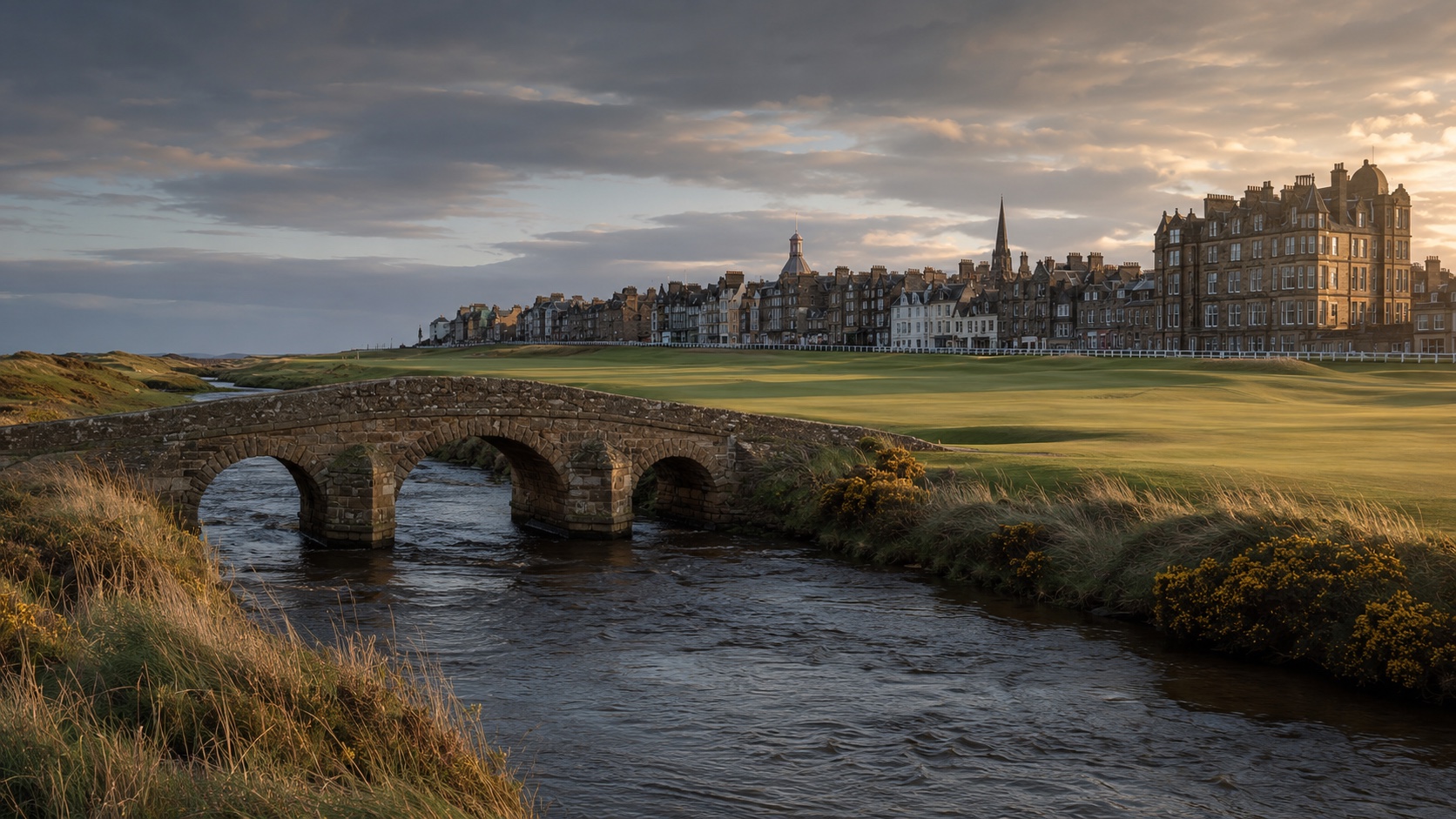
The oldest course in the world is not a private club. It is common land, held in trust by the St Andrews Links Trust under an Act of Parliament, and it has been played over since at least the early 15th century. There is no single architect; the course evolved across centuries, with Old Tom Morris shaping the 1st and 18th holes and Allan Robertson creating the famous double greens in the 1840s. The fairways are wide and the rough is minimal, which leads first-time visitors to underestimate how quickly a round can unravel. The Road Hole — the 17th, with its blind tee shot over a hotel replica and the Road Hole bunker guarding the green’s near side — remains one of the most strategically complex holes in the game. Access is managed through a daily ballot, entered two days in advance, open to any golfer carrying a valid handicap certificate. Tee times are also bookable through tour operators, though demand consistently outpaces supply.
Royal County Down — Newcastle, Northern Ireland
George Baillie laid out the original nine holes at Royal County Down in 1889, and Old Tom Morris was brought in the same year to advise on its expansion to eighteen. Harry Vardon, J.H. Taylor, and James Braid all contributed refinements over the following decades. But it was Harry Colt who made the changes that define the course today — most notably the 4th hole with its dramatically raised green and the 9th, which plays from a summit into a blind, dune-framed landing area. The course sits at the foot of the Mourne Mountains, with Dundrum Bay behind it and gorse in every shade of yellow consuming the rough. Few course photographs convey what it actually feels like to stand on those elevated tees. Royal County Down is a members’ club, with visitor access available on Mondays, Tuesdays, and Fridays. Advance booking is recommended, particularly in summer.
Ballybunion Old Course — Ballybunion, County Kerry, Ireland
The club was founded in 1893, reorganized in 1906, and remained largely obscure to the wider golf world until Tom Simpson visited in 1937 to prepare it for the Irish Championship and found himself confronted with something he had not expected: dune golf of an entirely different scale. The sand hills at Ballybunion are the largest and most formidable in Ireland, and Simpson made only a handful of changes, noting afterward that the course barely needed him. Tom Watson discovered the Old Course in 1981 with friend Sandy Tatum and became one of its most vocal advocates, returning repeatedly in the decades that followed. The routing runs along the cliffs above the Atlantic, with cemetery ground bordering several holes and the Atlantic wind providing a variable no architect can design around. Ballybunion is a private members’ club that welcomes visitors throughout the year, with advance booking required.
Cabot Cliffs — Inverness, Cape Breton, Nova Scotia
The Cabot resort on Cape Breton Island offers two courses worth serious attention. Cabot Links, designed by Rod Whitman and opened in 2011, sits on a former coal mine along the Gulf of St. Lawrence and plays as a true links over flat, exposed ground. But Cabot Cliffs — opened in 2015 and designed by Bill Coore and Ben Crenshaw — is the one that has drawn comparisons to the great coastal courses of Ireland and Scotland. The routing climbs and descends dramatic headlands above the Atlantic, with several holes requiring tee shots over open water to fairways carved into the clifftop. Mike Keiser, who also developed Bandon Dunes, backed the project. Both courses are open to guests staying at the resort, with rounds available to non-staying visitors on a limited basis. The remoteness — Cape Breton is not on the way to anywhere — is part of the calculation, and most serious golfers plan a multi-day stay.
Bandon Dunes — Bandon, Oregon
Mike Keiser purchased roughly 1,200 acres of coastal Oregon dune land in 1991, and the first Bandon Dunes course — designed by Scotsman David McLay Kidd — opened in 1999. What followed was an expansion that now encompasses five full courses and two short courses, each distinct in character and collectively unmatched in North America as a walking-only, caddie-recommended, weather-engaged links destination. Pacific Dunes, designed by Tom Doak, opened in 2001 and is consistently ranked among the continent’s finest. Bandon Trails (Coore & Crenshaw) runs through the forest rather than along the bluffs, offering a different kind of examination. Old Macdonald, a Doak and Jim Urbina design honoring Charles Blair Macdonald’s template hole philosophy, rounds out the core rotation. All courses are open to the public, with resort guests enjoying advance booking priority. The Oregon coast’s indifference to the calendar — fog and wind are as likely in July as in November — is not a deterrent for the right kind of golfer.
Royal Melbourne Golf Club (West Course) — Melbourne, Victoria, Australia
Alister MacKenzie arrived in Melbourne in October 1926 and, over a matter of weeks, laid out the West Course in collaboration with club member Alex Russell, who oversaw construction after MacKenzie departed for his next commission. The sandbelt south of Melbourne turned out to be among the finest ground for golf architecture anywhere in the world, and MacKenzie’s routing — with its wide, irregular fairways, bold bunkering, and greens designed to penalize the wrong half of the approach — set the standard for every course that followed in the region. The West Course is a private members’ club, with international visitors generally able to book on Mondays, Tuesdays, and Fridays by contacting the club directly. A letter of introduction from one’s home club is required, and caddies are compulsory for overseas visitors.
Le Golf National (Albatros) — Saint-Quentin-en-Yvelines, France
Le Golf National’s Albatros course was designed by Hubert Chesneau and Robert von Hagge, opening in 1990 outside Paris near Versailles. It was built as a championship arena rather than a traditional parkland layout, with water features integrated into the design in a way that is more continental than British, and with earthwork mounds that function as natural spectator stands. The course hosted the 2018 Ryder Cup — Europe’s last home victory — which confirmed its standing as the defining championship venue in continental golf. It is a public course with a handicap limit for the Albatros, making it one of the more accessible courses on this list and one that rewards a detour from central Paris without requiring any particular connection.
On Access, and Why It Matters
The courses above span the full range of access: public resort, ballot-driven public trust, visitor-welcoming private club, and entirely invitation-only. What they share is that each requires a certain deliberateness to reach — a decision to build a trip around a course rather than simply include it. That calculus is increasingly the province of serious golf travelers, and the orchestration of it — knowing which courses offer visitor windows, which ballot systems reward persistence, which private clubs extend courtesies to visiting members of comparable clubs abroad — has become a distinct discipline. Networks like LXV exist precisely because this knowledge is unevenly distributed, and because a warm introduction opens doors that a cold inquiry does not. The courses on this list will reward whoever shows up with the curiosity they deserve. The question is only how you get there.