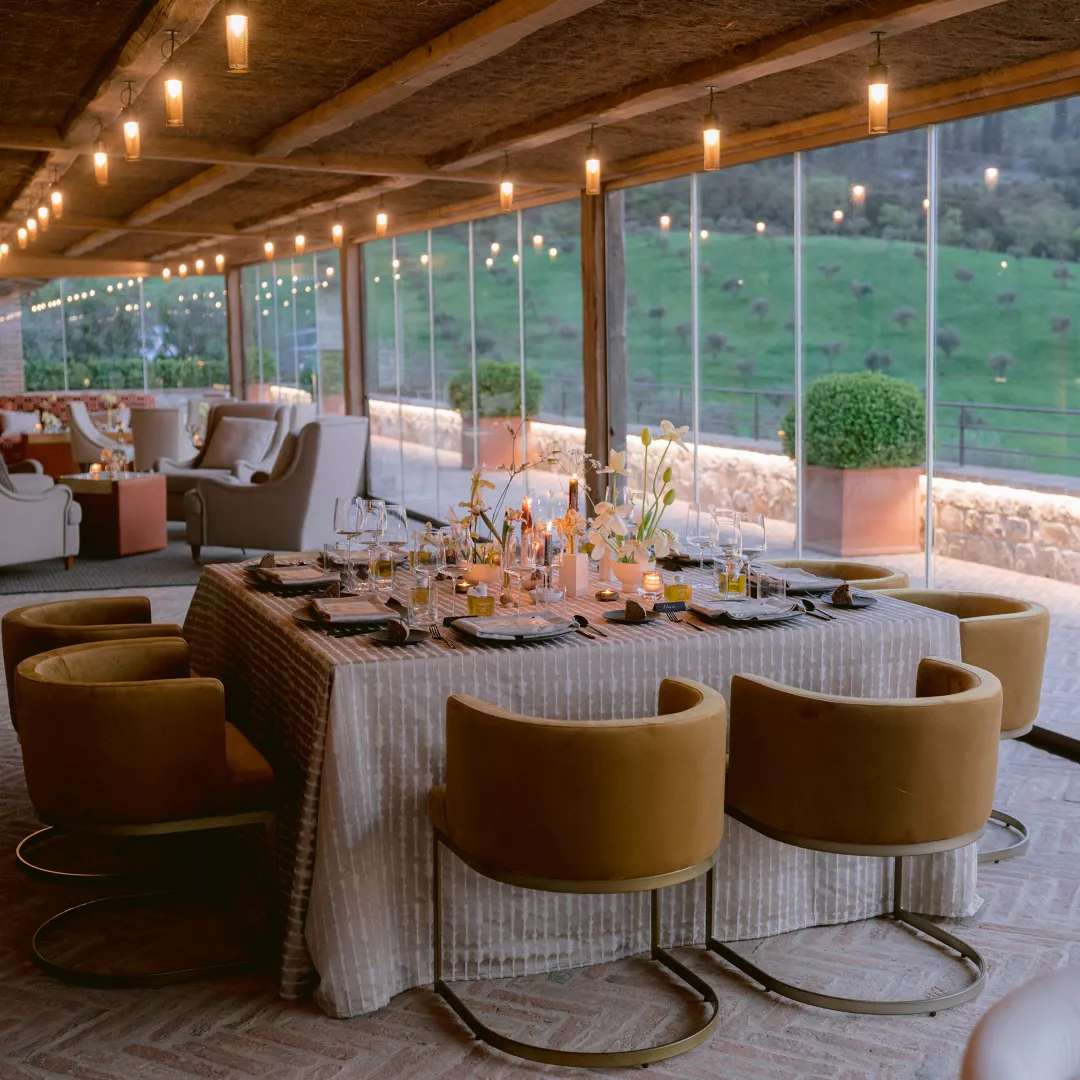
The drive in sets the terms. You follow a cypress-lined road through terrain that has barely changed in eight centuries, past Sangiovese vines and stone farmhouses, until a medieval borgo rises from the ridge above the Val d’Orcia. This is the first impression of the Castiglion del Bosco golf club — and the estate behind it — and it is deliberately unhurried. Massimo Ferragamo, who acquired the property with his wife Chiara in 2003, did not build a resort. He restored a civilization.
An Estate With a Longer Memory Than Most Countries
Castiglion del Bosco has been occupied since roughly 600 BC, when Etruscan settlers recognized the elevated position above the Orcia River valley as a natural defensive outlook. By the twelfth century it had grown into a fortified hilltop settlement; the stone tower that still marks the borgo’s skyline dates to that period. The old Via Francigena — the pilgrimage road connecting Canterbury to Rome — ran directly through the estate, and the fourteenth-century frescoes inside the Church of San Michele Arcangelo, attributed to Pietro Lorenzetti, remain intact within the borgo today.
When the Ferragamos arrived, they found a 5,000-acre estate in need of comprehensive restoration. What followed was a twelve-year project: the borgo’s historic buildings were converted into 23 suites, eleven private villas were reconstructed from 17th- and 18th-century farmhouses using local stone and antique timber, and the estate’s winery — a founding member of the Consorzio del Vino Brunello di Montalcino since 1967 — underwent a full technical overhaul. In 2014, Rosewood Hotels took over hotel operations, though the Ferragamos retain the estate, the golf club, and the winery.
The Wine That Precedes the Golf
Before a single fairway was laid out, Castiglion del Bosco was already one of the larger Brunello estates in Montalcino, farming 62 hectares of Sangiovese Grosso across its UNESCO-protected hills. The 1967 founding membership of the Brunello Consortium places the estate among the original custodians of what would become one of Italy’s most closely regulated DOCG appellations. Ferragamo’s investment in the winery modernized both the cellar and the viniculture without departing from traditional practices: long maceration, extended oak aging, no shortcuts on release timelines.
The estate produces Brunello di Montalcino, Rosso di Montalcino, and a Sangiovese-based Ignaccio IGT. Members of the golf club have access to the winery and its private tastings; the nineteenth hole — a short par-3 known as the Brunello Hole — settles matches with a magnum of the estate’s own wine.
What Tom Weiskopf Built — and Why It Matters
When Massimo Ferragamo asked Tom Weiskopf to design the course, he gave him a brief that amounted to creative latitude and an architectural challenge: build something worthy of the landscape, and do it without disturbing the working vineyard or the UNESCO buffer zone. Weiskopf — a 1973 Open Championship winner and one of the most respected course architects of the late twentieth century — had never designed in continental Europe. Castiglion del Bosco would be his only project on the continent.
The course opened in 2012. It is an 18-hole, par-72 layout that splits across two distinct nine-hole loops. The outward nine descends through a road tunnel onto a river valley floor, playing through natural water hazards and mature cypress rows before climbing back toward the estate. The inward nine moves through higher terrain with panoramic sightlines across the Val d’Orcia. Weiskopf’s stated design references were the rows of cypress, the dramatic elevation changes, and the natural drainage patterns of the land — not a catalog of borrowed features from elsewhere.
The course’s most discussed statistic: the par-5 13th measures 685 yards from the championship tees, making it the longest par-5 in Europe. It is not a novelty. On ground with this much vertical movement, the yardage is a consequence of the terrain rather than a stunt. The Brunello Hole — the informal nineteenth — is a short par-3 reserved for members and their guests, a final act played for stakes that have nothing to do with handicaps.
The Club: Private by Structure, Not by Affectation
The Castiglion del Bosco golf club operates under the name Drago Golf Club, and it functions as a genuine private membership organization. Membership is by invitation. There is no public tee-sheet. The only other path onto the course is through the hotel: resident guests of Rosewood Castiglion del Bosco have access to a limited allocation of reserved tee times, which means the course never becomes a hotel amenity in the way that most resort golf does. The ratio of members to guests is kept deliberately narrow.
The practical effect is a playing experience that bears little resemblance to the average European resort round: no starter with a clipboard, no four-ball backed up at the par-3s, no halfway house queue. The caddie program, the practice facilities, and the post-round infrastructure are calibrated to a membership-first operation that happens to accommodate hotel guests at the margins.
The Borgo, the Villas, and What Surrounds the Golf
The hotel itself operates at a scale that suits the estate: 23 suites in the historic borgo, eleven villas spread across the wider 5,000-acre property. The villas — reconstructed from original stone farmhouses — are available year-round and carry their own private outdoor space, kitchen facilities, and access to the full hotel program. For longer stays or groups, they represent the more coherent choice: you are living inside the estate rather than adjacent to it.
Dining centers on two rooms with different registers. Ristorante Campo del Drago earned its second Michelin star in the 2025 Guide Italy, operating as a serious tasting-menu destination that draws on the estate’s wine program directly. Osteria La Canonica functions as the estate’s trattoria — simpler, lunch-appropriate, without pretension. A cooking school, The Spa, and direct access to the winery cellars complete the residential offer.
The Val d’Orcia’s UNESCO designation protects the landscape around the estate from development, which means the view from the 18th green is functionally the same view it has been for two centuries. Siena is forty-five minutes by car. Pienza is closer. Montalcino itself — the medieval hill town that defines this wine region — is a ten-minute drive.
Why LXV Members Come Here
For most golfers, Italy means public-access resort courses, often on reclaimed agricultural land, where the backdrop is beautiful and the golf is fine. Castiglion del Bosco operates on a different premise: a course built for a private membership, on land with genuine historical weight, designed by an architect who treated the assignment as a singular creative problem rather than a standard commission. Access through the Rosewood is real access — not a truncated guest version of the full experience — because the membership structure demands that even hotel rounds meet the same standard.
The estate is also, frankly, one of the more coherent arguments for Tuscany as a wine-and-golf destination: the bottle you open at dinner shares a provenance with the land you walked that morning. That coherence is harder to manufacture than any individual amenity, and at Castiglion del Bosco it is not manufactured at all — it is simply what the estate has always been.
Keep reading
- The Most Exclusive Golf Clubs in the World
- The Golf Courses Worth Building a Life Around
- How to Play Pebble Beach: Tee Times, Cost, and Access in 2026
One network, dozens of destinations. Castiglion del Bosco is the kind of property LXV members reach through a single membership — alongside reciprocal access to the world’s most exclusive private clubs. Apply for membership →