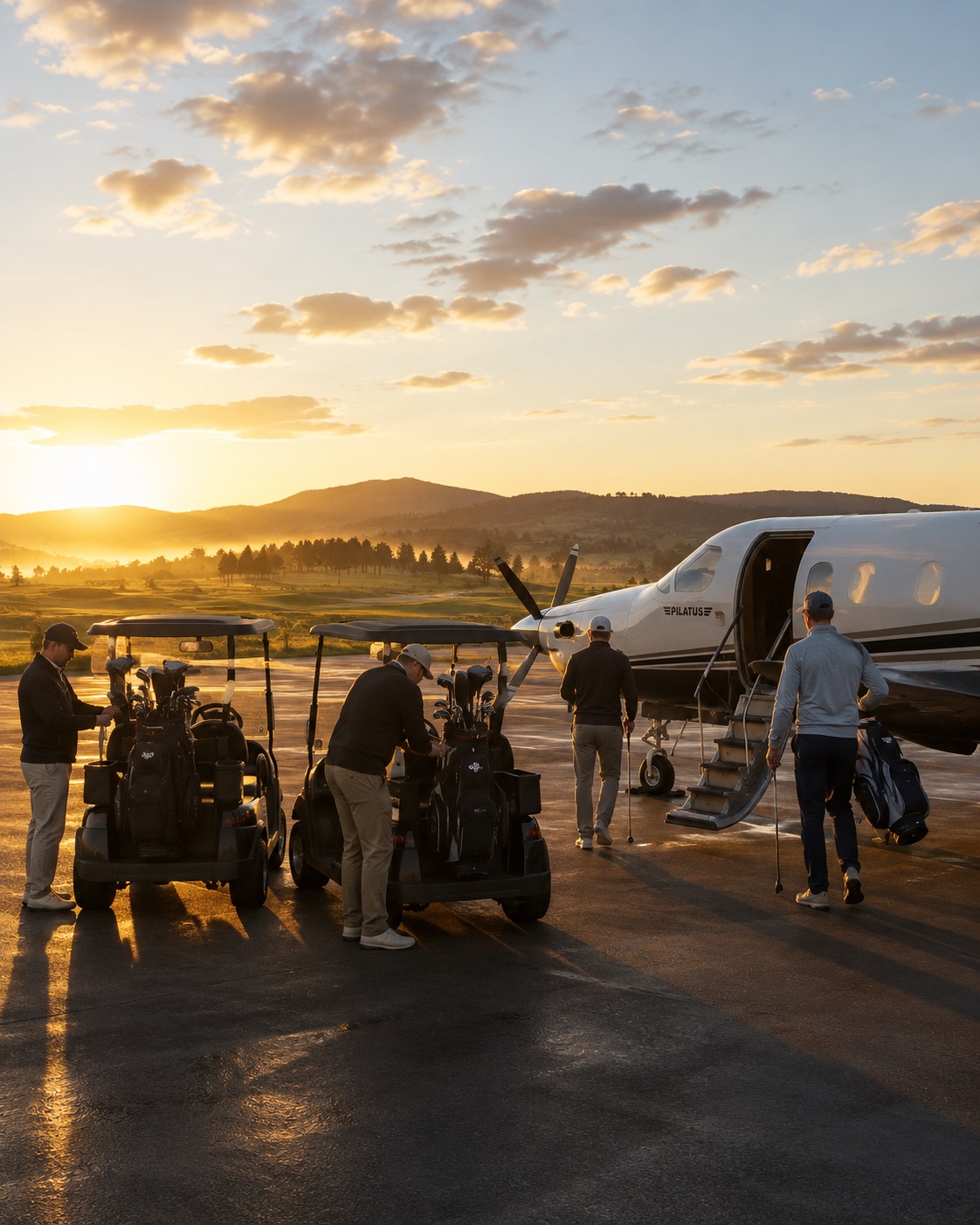
There is a particular kind of quiet that settles over a private airfield at golf-course altitude — engines cooling, a Hill Country ridgeline or a Nova Scotia shoreline unspooling beyond the wingtip, a starter already radioing ahead that the cart is waiting. For members who measure a trip not in hours but in the friction removed from it, this is the real luxury: no terminal, no layover, no ninety-minute crawl from a regional airport. Wheels down, and the first tee is a golf-cart ride away.
Fly-in golf is not a marketing conceit. It is a small, rarefied category of resorts and clubs that were built — or have quietly built themselves out — around the idea that the runway is as much a part of the property as the clubhouse. Some own their airfields outright, FAA-coded and staffed by a dedicated FBO. Others sit beside a private airport close enough that the distinction barely registers by the time the second martini arrives. What they share is an understanding that for a certain guest, privacy and pace begin the moment the aircraft leaves cruising altitude — and that a golf trip planned around a private airport is a fundamentally different kind of travel.
Here are the properties that earn the claim.
Horseshoe Bay Resort — Texas Hill Country
No fly-in golf story starts anywhere but here. Horseshoe Bay Resort Airport (KDZB) sits directly on the resort grounds above Lake LBJ, roughly an hour from Austin — a 6,000-foot lighted runway, the longest in the region, with its own FBO, the Resort Jet Center, running Jet-A service seven days a week. Aircraft taxi in against a backdrop of the lake and the resort's golf, and guests are on property before the engines have fully spooled down. The golf is the other half of the legend: three Robert Trent Jones Sr. courses — Slick Rock, Apple Rock, and Ram Rock, together nicknamed the "Texas Triangle" and long ranked among the best-built courses in the country — plus the members-only Summit Rock, a Jack Nicklaus Signature design carved through dramatic Hill Country elevation change. It is the rare resort where the airfield and the architecture are both headline acts.
Nemacolin — Farmington, Pennsylvania
Set into the Laurel Highlands of southwestern Pennsylvania, Nemacolin's private airfield (FAA identifier PA88) is built into the resort itself — a 3,845-foot runway that comfortably handles light jets and turboprops, reservation-only through the resort's security desk with 48 hours' notice. On the ground, golf means Mystic Rock, Pete Dye's boulder-strewn, Sahara-bunkered par-72 that once hosted a PGA Tour event, alongside the resort's original Woodlands Course. Landing at Nemacolin means arriving somewhere genuinely remote — mountain, forest, silence — without sacrificing an inch of polish.
Fox Harb'r Resort — Nova Scotia
On Nova Scotia's Northumberland Shore, Fox Harbour Airport (Transport Canada ID CFH4) is a private, resort-built runway of roughly 5,000 feet — long enough for serious jet traffic — sitting a mile and a half from the property Tim Hortons co-founder Ron Joyce built as one of only a handful of five-star, four-diamond resorts in Canada. Guests can arrive by air or by the resort's own deep-water marina, a rare double threshold of exclusivity. The golf is Graham Cooke's championship design, a 7,205-yard par-72 that shifts from a parkland front nine to a Scottish-links back nine along the water, and has held its place among Canada's top-ranked layouts since opening in 2000.
The Retreat at Silvies Valley Ranch — Eastern Oregon
Silvies is fly-in golf at its most improbable and its most rewarding: a private airstrip (OG14) at 4,584 feet elevation, deep in Oregon's high desert seven miles south of Seneca, open seasonally from June through October, daylight landings only. There is no fuel and no hangar — just 5,000 feet of asphalt and a ranch shuttle waiting. What's on the other end justifies the remoteness: Dan Hixson's reversible Hankins and Craddock courses, eighteen holes that play as two entirely different routings depending on the direction, plus the par-3 Chief Egan course and McVeigh's Gauntlet, a wild seven-hole detour along a ridgeline. It is the most far-flung entry on this list, and arguably the one where a private airplane isn't a luxury so much as a necessity.
Sea Island — Georgia's Golden Isles
Sea Island doesn't own its airfield, but the distinction hardly matters once you're on the ground. McKinnon St. Simons Island Airport (KSSI), six miles from the resort, serves general aviation and private jets exclusively — no scheduled airline traffic to share the ramp with — making it the de facto private gateway to one of the Southeast's grand golf estates. On property, three courses carry serious pedigree: Seaside, a Colt & Alison original refined by Tom Fazio and home to the PGA Tour's RSM Classic; Plantation, reshaped by Rees Jones and later by Davis Love III; and Retreat, a Love-designed layout built for a gentler, more sociable round. Add the Cloister's beachfront setting and Sea Island reads less like a stopover and more like a coastal golf capital reachable in a single short hop.
Gasparilla Inn & Club — Boca Grande, Florida
On the barrier island of Gasparilla, two miles from the century-old Gasparilla Inn, Coral Creek Airport (FA54) is a privately owned field that extends limited access to Inn guests during the resort's October-to-June season — effectively a private airport for a resort that has quietly hosted old-money Florida since 1913. The golf course, redesigned by Pete and Alice Dye and reopened in 2004, plays as its own private island within the island, a sun-bleached, palm-lined test that rewards a soft touch over raw length. Between the Old Florida architecture, the Gulf light, and an airfield built for exactly this kind of arrival, Boca Grande remains one of the most understated fly-in golf destinations in the country.
The Ethos of Arrival
What links Horseshoe Bay's Hill Country runway to a seasonal strip in the Oregon high desert is not runway length or FBO amenities — it's an idea about time. These are places built, deliberately or by fortunate proximity, for members who have already decided that a golf weekend shouldn't cost them a travel day. That same instinct — toward access without friction, privacy without compromise — is what LXV was built to curate: a network of clubs and experiences where the standard is never advertised, only delivered. The runway is simply where it begins.