The Entire Supply Is Ten Courts
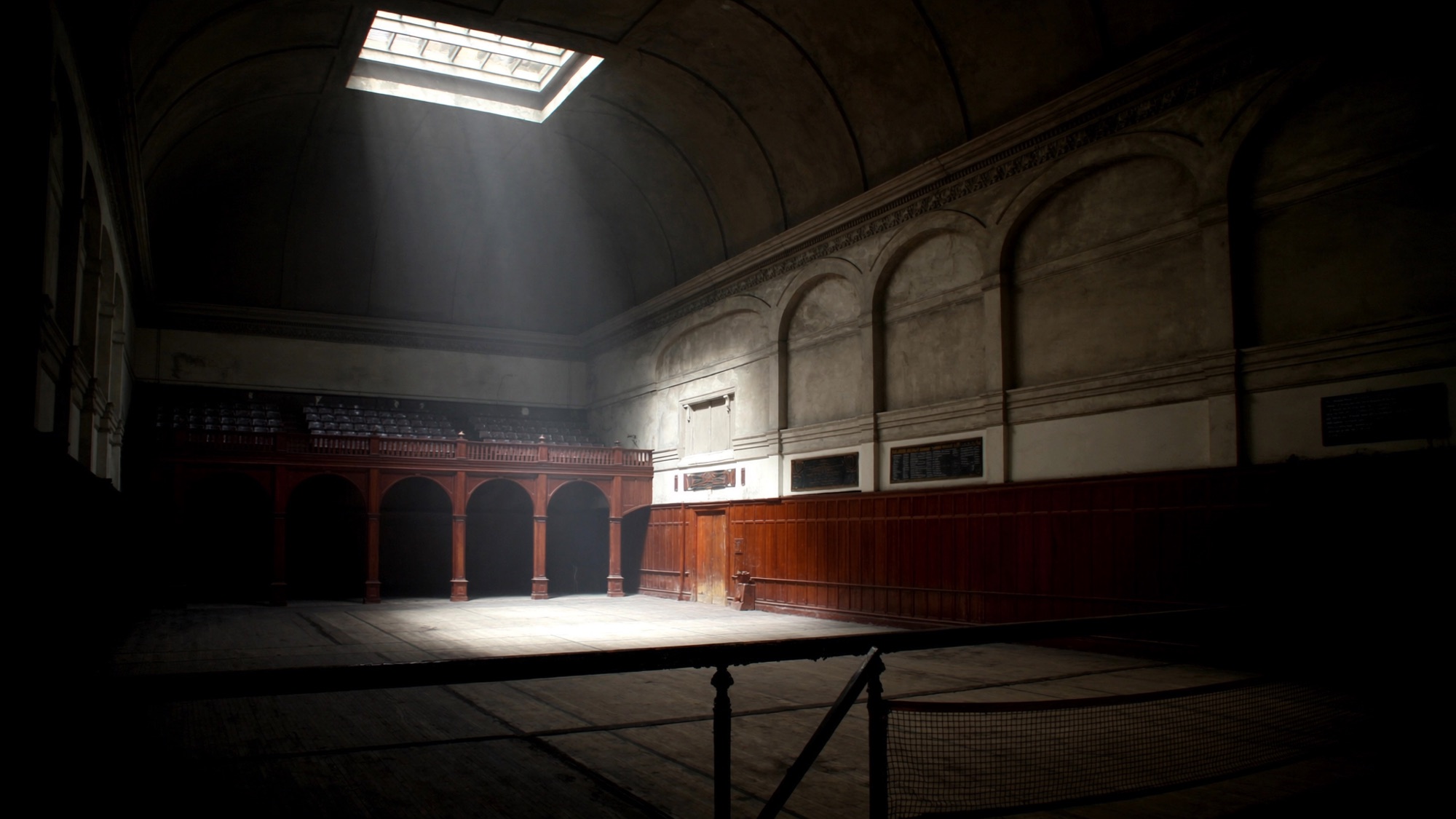
Nine clubs in the United States maintain an active real tennis court. Not tennis — real tennis, also called court tennis: an asymmetrical, walled indoor game played with lopsided wooden racquets and a hand-stitched ball, the direct ancestor of the sport that will crown champions at Flushing Meadows this September. Wikipedia’s own count puts the world’s active supply at 45 courts across four countries. America’s entire share is ten courts, because the Racquet and Tennis Club in New York alone holds two — spread across the Racquet and Tennis Club, the Tuxedo Club, the Tennis and Racquet Club in Boston, the Racquet Club of Philadelphia, the Racquet Club of Chicago, the National Tennis Club at the International Tennis Hall of Fame in Newport, the Aiken Tennis Club in South Carolina, Georgian Court in Lakewood, New Jersey, and the International Tennis Club of Washington at Westwood Country Club in Vienna, Virginia. That list has barely moved since the U.S. Court Tennis Association was founded in 1955.
It is not a niche statistic. It is the actual shape of exclusivity in American racquet sports: not “hard to book,” but structurally, physically finite. The twelve clubs below were chosen because each holds an equivalent scarcity — a surviving grass court, a landmarked clubhouse, a tournament history that predates the US Open by decades. The US Open itself runs August 23 through September 13 this year at Flushing Meadows, a venue that inherited the tournament from one of the clubs on this list. Initiation fees at this tier are almost never published, and where a club has genuinely disclosed nothing, we say so rather than guess.
The Racquet and Tennis Club — New York, New York
The Racquet and Tennis Club occupies 370 Park Avenue, between East 52nd and 53rd Streets, in a five-story Italian Renaissance building designed by William S. Richardson of McKim, Mead & White and completed in 1918 — the firm’s final commission before Charles McKim’s partner Stanford White’s death effectively ended the practice’s original era. Designated a New York City Landmark in 1979 and listed on the National Register of Historic Places in 1983, the clubhouse holds two of the country’s ten active court tennis courts, a racquets court, and a hardball squash program that dates its first tournament to 1902. Membership has historically been restricted to men. Initiation fees and membership counts are not publicly disclosed.
Tuxedo Club — Tuxedo Park, New York
Pierre Lorillard IV founded the Tuxedo Club in 1886 as the social anchor of the private village he built an hour north of Manhattan. Its court tennis court, opened December 30, 1899, and built by the architectural firm Warren and Wetmore, is constructed of Bickley cement with stone and brick arches and full spectator galleries; Wikipedia’s own account of the building calls it a model for the court tennis facilities built afterward elsewhere in the country. The club is — disputedly — credited with originating the tailless dinner jacket that took its name from the village; the connection is repeated constantly and confirmed by no one. Today the club still fields golf, lawn tennis, racquets, squash, and its original court tennis court, active and USCTA-listed.
Tennis and Racquet Club — Boston, Massachusetts
Founded in 1902 at 939 Boylston Street in the Back Bay, the Tennis and Racquet Club was designed by the firm Parker and Thomas and built by Frank L. Whitcomb in a classical revival style typical of the Back Bay’s grander private buildings of the period. It still contains its original real tennis court and racquets court — one of the nine active court tennis venues in the country — alongside three international and three North American squash courts. Some of the building’s original social rooms have since been leased out as office and restaurant space, a small commercial concession that has not touched the courts themselves, which remain reserved for members. The club remains privately governed and members-only, with fees and membership size undisclosed.
Racquet Club of Philadelphia — Philadelphia, Pennsylvania
The Racquet Club, organized in 1882 and incorporated in 1889, moved into its current clubhouse at 215 South 16th Street in 1907, a Horace Trumbauer design that was among Philadelphia’s first reinforced-concrete buildings and originally housed the world’s first above-grade swimming pool, engineered by the Roebling Construction Company. Its single court tennis court and single racquets court are both active; squash doubles was reportedly invented on the premises by member Frederick C. Tompkins. In 2025, the club hosted the U.S. Open in court tennis — not the one at Flushing Meadows, and considerably harder to get a ticket to.
Racquet Club of Chicago — Chicago, Illinois
Built in 1923 at 1365 North Dearborn Parkway in the Gold Coast Historic District, the Racquet Club of Chicago was designed by architect Andrew Rebori in the classical revival style. Its real tennis court sat dormant for decades before a full restoration reopened it in 2012, and its two racquets courts are, per the club’s own Wikipedia entry, the westernmost active venue for that sport anywhere in the world — there is nowhere farther west on the globe, in either direction, still playing it. The club also runs two North American doubles squash courts and one international singles court. As with its Eastern peers, dues and membership figures are not published.
National Tennis Club, International Tennis Hall of Fame — Newport, Rhode Island
Before there was a US Open, there was the Newport Casino: a Victorian shingle-style complex designed in 1880 by Charles McKim, with interiors by Stanford White, that hosted the inaugural US National Championships in 1881 and every edition through 1914. The court tennis facility housing the National Tennis Club was built onto the campus’s east end that same year, 1881, and remains active today under the U.S. Court Tennis Association. In 1954, Jimmy Van Alen installed the National Tennis Hall of Fame inside the Casino itself — the institution now known as the International Tennis Hall of Fame. The tournament that became today’s US Open was born on this court tennis club’s grounds.
The Meadow Club — Southampton, New York
The Meadow Club opened in Southampton in 1887 and today maintains 36 grass courts across more than 18 acres at 555 First Neck Lane, among the largest remaining concentrations of natural-grass tennis surfaces in the country. Its invitational tournament, staged intermittently from 1888 to 1973 across 85 editions, drew champions including Bill Tilden, Bobby Riggs, Rod Laver, and Fred Stolle before folding as the sport’s Open era moved marquee tennis onto hard courts. The club still operates as a private summer institution of the Southampton colony. Initiation fees and membership figures are not publicly disclosed.
Seabright Lawn Tennis and Cricket Club — Rumson, New Jersey
Seabright dates its founding to 1877, when a group of Monmouth County residents began ordering tennis equipment for a cricket ground later converted to lawn courts; the club states it is the oldest lawn tennis club in the United States. Its 1886 Tudor Revival clubhouse, designed by the firm of James Renwick, stands on grounds at 5 Tennis Court Lane that earned National Historic Landmark status in 1992 — one of only a handful of American tennis facilities to hold it. The club’s invitational tournament ran into 1950, with Bobby Riggs and Alice Marble each winning four titles. Bill Tilden and Helen Wills both played there regularly in the 1920s.
West Side Tennis Club — Forest Hills, Queens, New York
Founded in 1892 on Manhattan’s Upper West Side before relocating to Forest Hills, the West Side Tennis Club hosted the US National Championships — the tournament that became the US Open — for 60 total editions across 1915 to 1920 and 1924 to 1977. Its horseshoe-shaped Forest Hills Stadium, designed by architect Kenneth M. Murchison and completed in 1923 for roughly 14,000 spectators, hosted more Davis Cup finals than any other venue in the world. The Open left for Flushing Meadows in 1978. The stadium now runs primarily as a concert venue, though pro tennis returned briefly in August 2024, when Nick Kyrgios headlined the Ultimate Tennis Showdown there. The club today fields 38 courts across grass, clay, Har-Tru, and hardcourt.
Longwood Cricket Club — Chestnut Hill, Massachusetts
Longwood was founded in 1877 on the Sears family’s former estate, named for the house on Saint Helena where Napoleon lived in exile; its first lawn tennis court followed in 1878. The club hosted the inaugural Davis Cup challenge in 1900, when the United States defeated Great Britain 3–0, and went on to host 15 Davis Cup ties in total — more than any American venue besides Forest Hills. Its U.S. Pro Tennis Championships ran annually from 1964 to 1999, the year of the club’s last top-flight professional match. Today Longwood maintains 25 grass and 19 clay courts across more than 700 members, and still hosts USTA national grass-court championships in family and age-group formats.
Merion Cricket Club — Haverford, Pennsylvania
Founded in 1865, Merion Cricket Club was designated a National Historic Landmark in 1987 for what its citation calls a leading role in the promotion and continued support of cricket, golf, squash, and tennis in the United States — a rare four-sport landmark designation. Its current clubhouse, the club’s sixth, was built in 1897 at 325 Montgomery Avenue in Haverford and designed by the Philadelphia firm of Frank Furness and Allen Evans, the latter a club founder. Three of the previous five clubhouses were lost to fire. On its grass courts, September 2 to 5, 1939, Merion hosted the Davis Cup Challenge Round before roughly 8,000 spectators; Australia’s John Bromwich and Adrian Quist beat Joe Hunt and a 17-year-old Jack Kramer in the decisive doubles rubber to take the tie 3–2. The club remains privately governed, with dues and membership size undisclosed.
The Los Angeles Tennis Club — Los Angeles, California
Incorporated October 28, 1920, under first president Thomas C. Bundy, at 5851 Clinton Street a block south of Melrose Avenue, the Los Angeles Tennis Club became the center of gravity for American tennis on the West Coast through the middle of the twentieth century. Architect Sumner Hunt’s Spanish Revival clubhouse won a local AIA award in 1925. The club hosted the Pacific Southwest Championships across two separate stretches, 1927 to 1974 and 1980 to 1983 — Wikipedia calls it the second most prestigious American tournament of its era — and its junior program produced Jack Kramer, Pancho Gonzales, and a young Billie Jean King, whom longtime executive Perry Jones once ejected from a club photograph for wearing shorts. It remains the only entry on this list west of Chicago, running 16 courts today for roughly 400 members.
The pattern across all twelve is the same: none of them are chasing relevance. The court tennis clubs keep courts that cannot be expanded because the sport has not changed since Henry VIII played it. The grass-court clubs keep lawns that require more maintenance than any hard court and admit that they will never again host what they once hosted. None of them have replaced what they lost with something bigger. They have simply kept what was already there.
That is the real difference between these clubs and a country club with a few tennis courts attached. A country club adds amenities. These clubs preserve a finite, physical thing — a walled room, a lawn, a landmark status — that cannot be replicated by spending money, only inherited by belonging to the institution that already has it. No developer can build a tenth court tennis court and call it the eleventh; the sport’s own governing body would not recognize it as part of the count. The US Open will crown its champions on hard courts at Flushing Meadows this September, on the site that inherited the tournament from West Side. The clubs above are where the tournament’s ancestors are still, quietly, played.