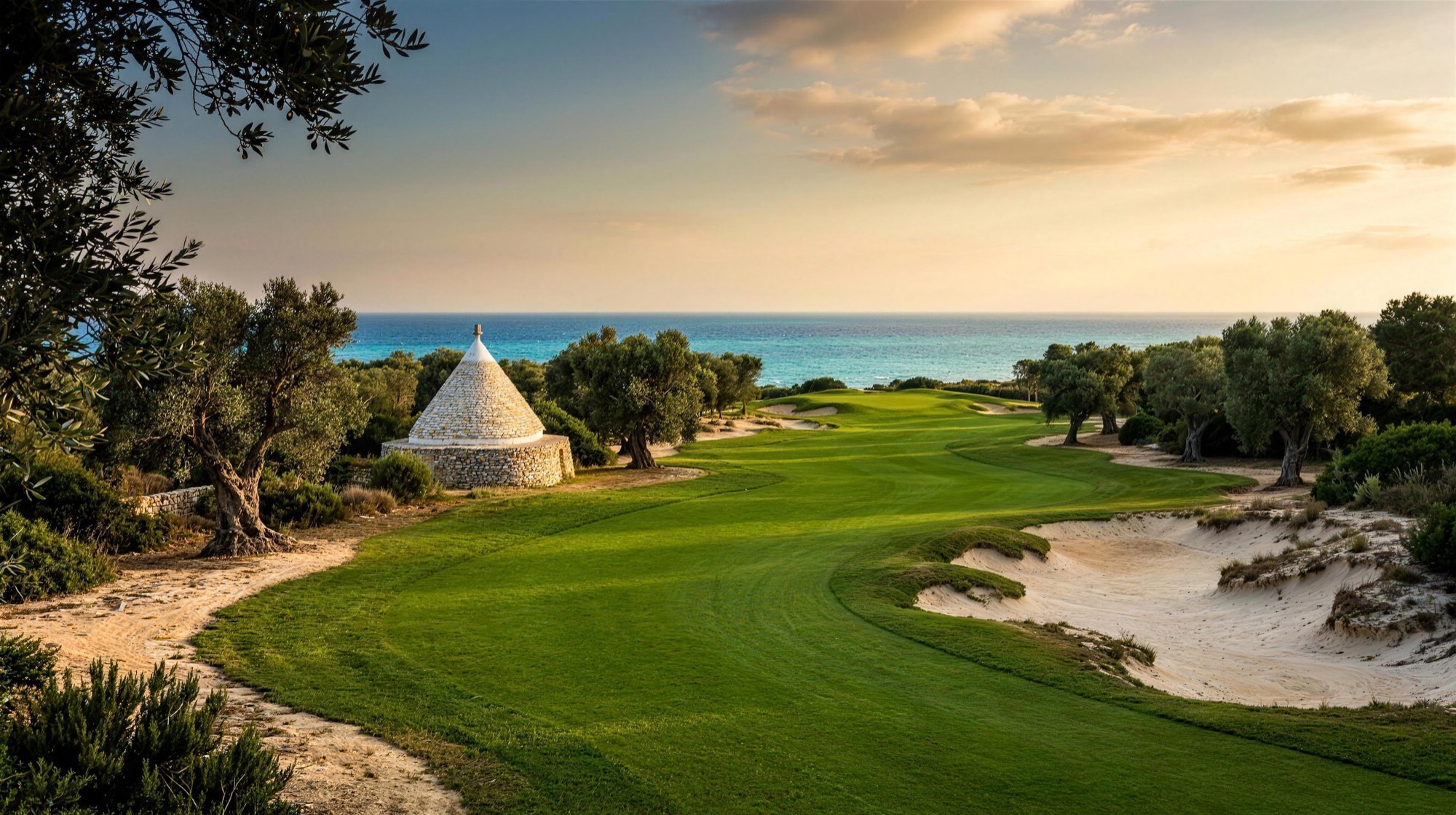
Puglia has spent a decade becoming one of the most desirable places in Italy to spend a week, and almost none of that decade has had anything to do with golf. The region’s luxury story was written by masserie — fortified stone farmhouses turned into hotels — and by Borgo Egnazia, which taught the world that the heel of the boot could compete with Tuscany on service and on scenery. What Puglia never had was a reason for a golfer to book the trip.
That changes in 2027. On a 202-hectare estate outside Maruggio, in the province of Taranto, a Swiss developer is building La Maviglia: an 18-hole championship course, a suites-only hotel, thirty-five villas and a 5,000-square-meter medical spa, on a budget reported at €200 million. It is the largest single luxury hospitality bet in southern Italy right now, and the golf is not an amenity bolted onto a resort. The golf is the reason the land was bought.
The Land
The estate sits less than a kilometer from the Gulf of Taranto, on the Ionian side of the peninsula — the quieter coast, away from the Adriatic beach clubs. The protected stretch of shoreline immediately below it, Monaco Mirante, is known locally as the mare dei sette colori, the sea of the seven colors, for the way the shallows band from white to jade to ink.
Turn inland and you are in Primitivo di Manduria, one of Italy’s serious wine appellations. The property carries olive groves, fig and almond trees, citrus and pomegranate, dune formations, and macchia — the low Mediterranean scrub that gives the coast its smell. It also carries more than forty trulli, the conical dry-stone huts that are Puglia’s architectural signature and, until now, have never been a strategic feature on a golf course anywhere.
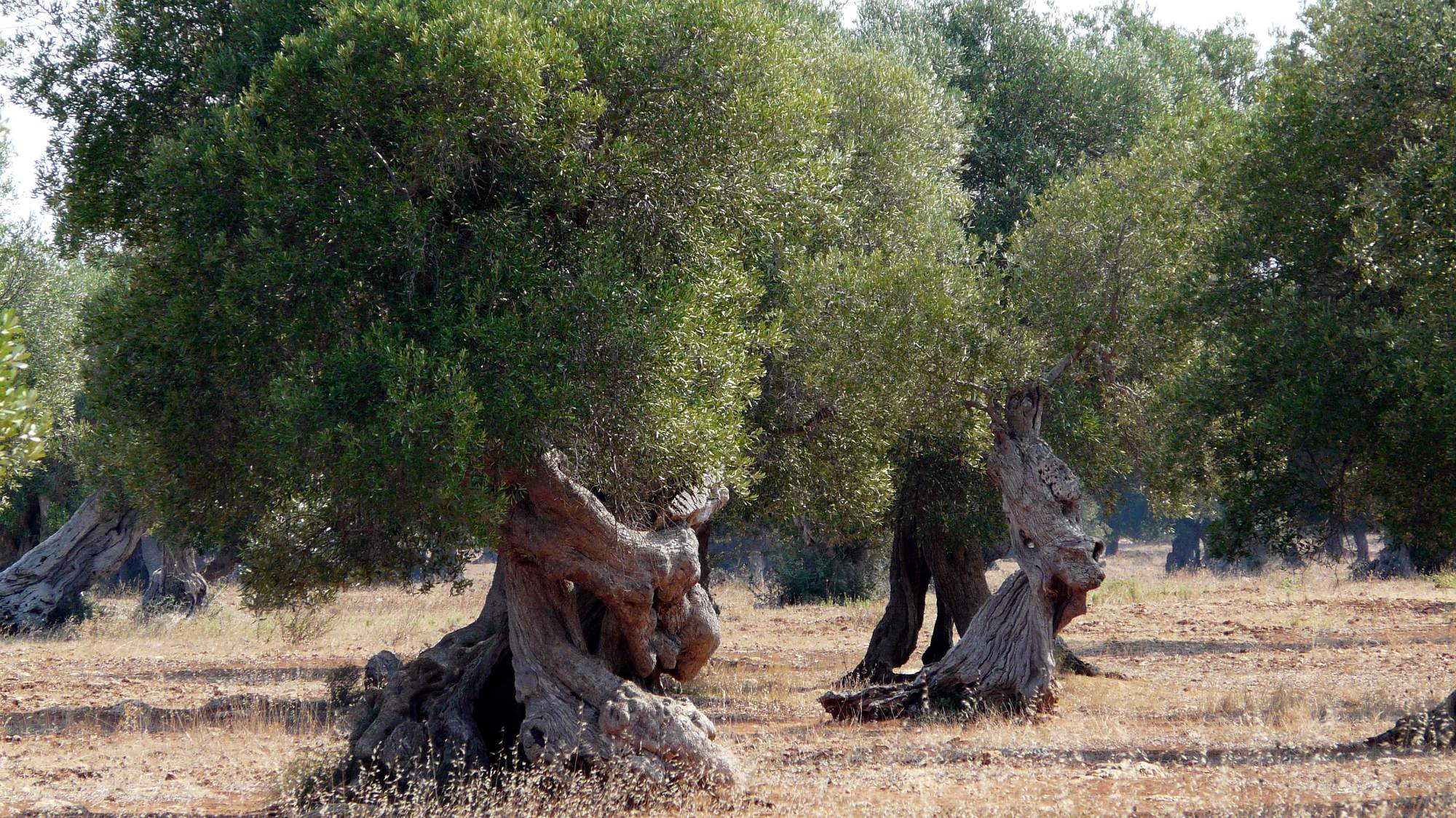
At the center is a 16th-century masseria, being restored and expanded by Oppenheim Architecture with Enea Landscape Architecture handling the grounds. A 12th-century castle, the Castello dei Commendatori, stands nearby in Maruggio itself. The pitch here is not that the resort was placed in an old landscape. It is that the old landscape was left largely intact and the resort was routed around it.
The Course
The 18 holes are the work of Städler & Reinmuth Golfdesign, the German practice behind some of continental Europe’s better modern work, spread across roughly 75 hectares — a generous allocation that suggests wide corridors rather than a course squeezed between real estate.
What is known of the routing reads well. Three lakes are being excavated, and the closing hole of each nine runs alongside water. Several holes carry central fairway bunkers, the strategic device that forces a decision off the tee rather than simply punishing a miss. Large expanses of sand are being left exposed as dune, which on this soil should look native rather than manufactured. And the trulli come into play both visually and strategically on multiple holes, along with an 18th-century neoclassical arch. Century-old olive and fig trees stay where they are.
Christoph Städler has described the site in terms of what was already on it — the old trees, the dunes, the macchia — which is the correct instinct on ground like this and not always the one a developer permits.
The Detail That Signals Intent
Every new resort announces a championship course. The tell is who is doing the unglamorous work underneath it.
Irrigation design at La Maviglia is Giles Wardle of Irriplan. Agronomy is Turfgrass — the same firm advising Adare Manor, which hosts the 2027 Ryder Cup. Those are not names a developer hires to build a resort course that will host member-guests. They are the names you hire when you intend to present tournament conditions in a hot, dry climate, and the project has said openly that the course is being built to host tour events.
In a region with essentially no championship golf infrastructure, that ambition matters more than the architecture. Italy has one recent proof point for what a course built to that standard can do: Marco Simone, outside Rome, hosted the 2023 Ryder Cup — Italy’s first — and moved the country from a golfing afterthought to a destination almost overnight. La Maviglia is being built by people who watched that happen.
The Resort
The accommodation is deliberately unconventional. There are 70 suites and no standard rooms. A separate 20-room hotel sits inside the golf complex itself, for guests whose trip is organized around tee times rather than the beach. Thirty-five villas, ranging from two to six bedrooms, are grouped in clusters across the estate.
There will be four chef-driven restaurants and a 5,000-square-meter wellness and medical spa — the scale at which a spa stops being a spa and becomes a diagnostic and longevity operation, which is where the top of the European resort market has been heading for three years.
The estate is also being run as a working agricultural property: renewable energy, organic vegetable farming, and its own olive oil and wine production. In Puglia that is less a sustainability claim than a description of what the land already does.
Who Is Building It
La Maviglia is the project of Ultimate Collection Ltd, based in Kilchberg, Switzerland, and led by Nicola Cortese — a Swiss-based Italian banker who ran the sports business desk at Credit Suisse and later managed private wealth at Banque Heritage in Geneva.
British readers will know the name from elsewhere. Cortese was executive chairman of Southampton FC from August 2009 to January 2014, brought in by owner Markus Liebherr after the club was bought out of administration, and he ran the rebuild that carried Southampton from League One back to the Premier League. He is project-managing La Maviglia personally.
The estate was acquired in 2023 for a reported €12 million. Building permits were signed on 13 September 2024 under Italy’s ZES Unica, the single special economic zone covering the south, which cleared the approval in under sixty days — a timeline that is close to unheard of for a project of this size in Italy, and the strongest single indicator that this one is real. The plan projects around 500 direct jobs.
What to Do About It
Nothing is bookable, and no membership structure has been published. That is precisely the useful moment.
Three things are worth noting now. First, access: Bari and Brindisi both serve the region, but the private airstrip at Taranto-Grottaglie is about twenty-five minutes from the gate, which puts La Maviglia in the same practical category as the fly-in properties that treat the runway as part of the estate. Second, timing: opening years slip, and a 2027 date on a course that broke ground in 2025 means the turf will be young at launch — the second and third seasons will be the ones worth flying for. Third, the pattern: Italy’s most exclusive golf has historically been attached to estates rather than clubs, as at Castiglion del Bosco in Tuscany, where the course and the villas were always one proposition. La Maviglia is built on the same logic at roughly ten times the scale.
If a Puglia trip is already on the calendar for 2027 or 2028, the sequencing is straightforward: watch for the villa release and the founding-member terms, both of which will come before the opening and both of which will be priced against a course nobody has played yet. That is usually the best number this kind of property ever offers.