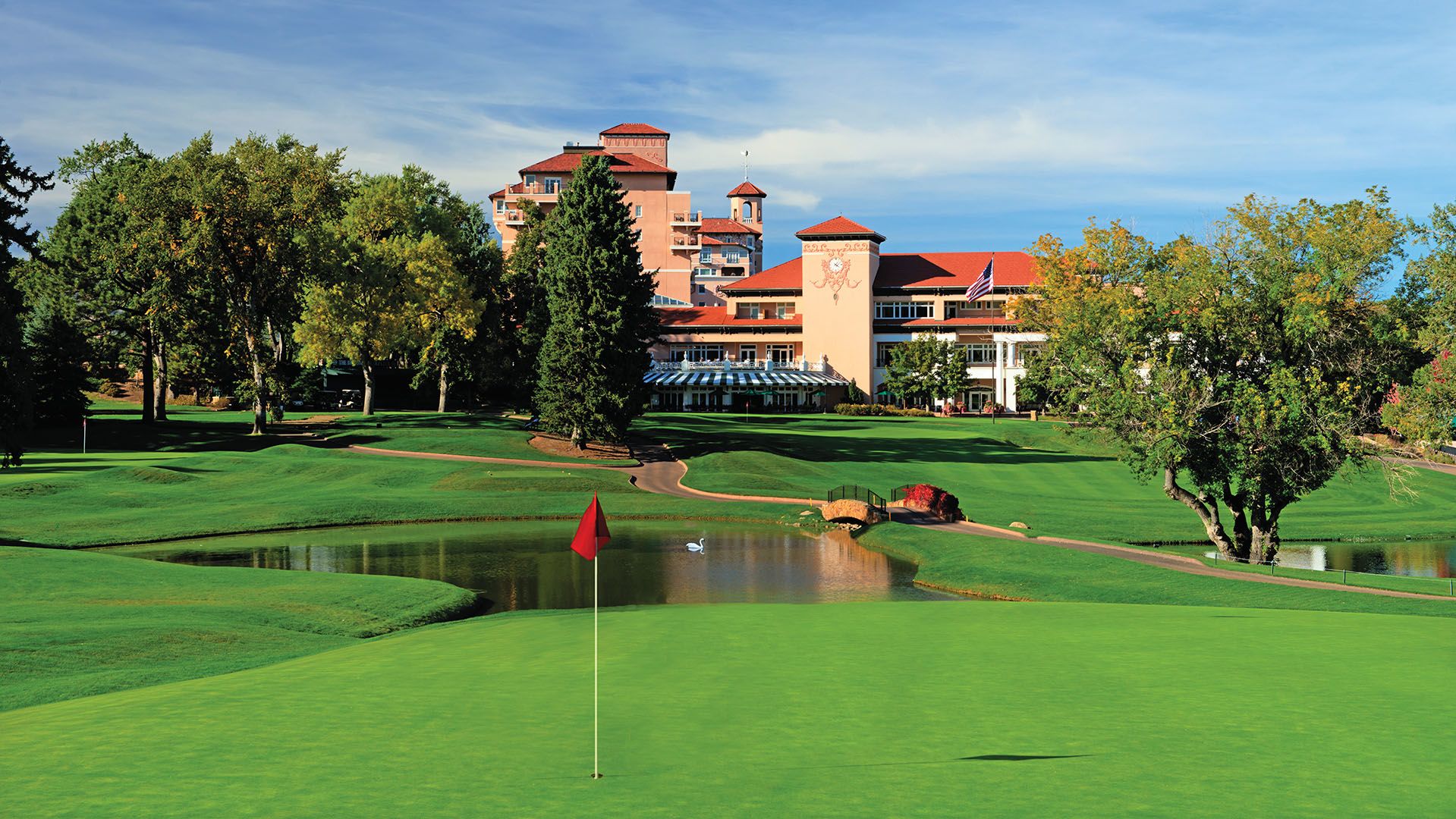
The Broadmoor opened on June 29, 1918, and has not closed since. That fact alone separates it from most American resorts that traffic in heritage: Spencer Penrose’s pink Italian Renaissance hotel at the foot of Cheyenne Mountain is not a restoration project or a rebranded property — it is the original thing, continuously operating for more than a century, holding Forbes Five-Star and AAA Five Diamond ratings longer than any other hotel in the country. The golf came first, commissioned by Penrose before the hotel opened, and the two have been inseparable ever since.
The Architecture of American Golf History
In 1916, Penrose hired Donald Ross to design the original course. Ross, whose work at Pinehurst, Seminole, and Oakland Hills had already established him as the defining architect of early American golf, later called The Broadmoor layout his finest work — a claim he did not make lightly. The course opened in 1918 at 6,400 feet, then the highest golf course in the United States.
What followed over the next five decades was a layering of American golf’s most important lineages. Robert Trent Jones Sr. was brought in for additional holes in the late 1940s, and by 1952 the first reconfigured East Course — nine of Ross’s original holes married to nine new Jones holes — was open. By 1965, Jones had returned again, and the modern East and West layouts took their current form: the East a collaboration between Ross and Jones, the West drawing on the original Ross routing expanded by Jones to a full 18. Arnold Palmer and Ed Seay added the Mountain Course in 1976; Nicklaus Design renovated it in 2008. Three courses, four architects across four generations. No other American resort carries a comparable design pedigree across a single property.
The East Course: Where Championships Are Decided
The East is the Broadmoor’s signature layout and the one that has absorbed the USGA’s attention. It has hosted the U.S. Amateur in 1959 and 1967, the U.S. Women’s Open in 1995 and 2011, and the U.S. Senior Open in 2008 and 2018, with future Senior Opens already awarded for 2025, 2031, and 2037 — a recurrence schedule that reflects institutional confidence in the venue. The 2025 Senior Open marked the ninth USGA championship conducted here.
From the championship tees, the East plays to approximately 7,264 yards at a par of 70 for tournament setup, or a par-72 from resort tees. The elevation — still around 6,400 feet in the valley below Cheyenne Mountain — adds meaningful carry distance. The course rewards accuracy over raw length; Ross’s original holes retain his characteristic contoured greens with subtle false edges, while the Jones holes bring more pronounced bunkering and defined approach corridors. The combination makes the East a course that reads differently on a second or third round.
The West Course and Mountain Course
The West plays to par-71 at just over 7,000 yards from the back tees, elevated above the main resort at roughly 6,800 feet. Where the East opens into wider corridors, the West tightens: tree-lined doglegs, steeply angled greens, and angles that require positional thinking off the tee. The views — Colorado Springs to the northeast, the Front Range filling the western horizon — are unobstructed from several elevated holes, and the course plays measurably harder in afternoon wind.
The Mountain Course, designed by Palmer and Seay at 7,637 yards from the tips, sits two miles south of the main resort and was renovated by Nicklaus Design in 2008. It has been closed since 2015 following land slippage on the property. Prospective guests should confirm current status before planning around it.
The Resort and Its Setting
The hotel at the center of the property is 784 rooms across the original main building, cottages, and newer lake-facing structures — all built around Cheyenne Lake, the small body of water that Penrose incorporated into the original site plan. Cheyenne Mountain rises directly behind the complex, and the view from the upper floors and from the course is genuinely dramatic at any hour. The Penrose Room, The Broadmoor’s flagship dining room, holds its own Forbes Five-Star designation. The spa carries the same rating.
The full property, including wilderness outposts and forest camp annexes in the surrounding Pike’s Peak region, extends across 5,000 acres. The core resort is self-contained in a way that invites longer stays: tennis, shooting, fly fishing, and hiking trails are on the program, and the Wilderness Experience properties — Cloud Camp and Fly Fishing Camp — offer high-altitude extensions for guests who want to move beyond the main compound.
How to Get a Tee Time
Golf at The Broadmoor is not public. The courses are open exclusively to overnight resort guests and members of the Broadmoor Golf Club. There are no walk-up times, no day-guest arrangements, and no workaround through adjacent properties. A stay at the hotel is the access mechanism.
Tee times for resort guests become bookable on January 1 of the current year, by phone through the golf operations desk. Prior to 2 p.m. between May and November, carts or caddies are required on all courses — the caddie program is active and worth using on the East, where local knowledge of the Ross greens reads in a way that GPS yardage charts do not fully capture. The daily green fee includes cart, bag transport between hotel and course, locker room access, and range use.
Shoulder season — late April and October — typically offers better course access and cooler morning temperatures without the afternoon thunderstorm window that characterizes Colorado’s mid-summer. The courses close in winter.
One Hundred Years of Elevation
What separates The Broadmoor from other American resort golf properties is not the mountain scenery or the Forbes ratings, both of which can be found elsewhere. It is the unbroken continuity of the project — a hotel and golf club that have operated together since 1918, that have hosted the game’s governing body across nine championships, and whose design pedigree runs from Donald Ross through Robert Trent Jones Sr. to Arnold Palmer. The elevation is physical as well as historical. The air is thin. The greens break more than you expect. And the East Course, which Ross called his best work, plays exactly as hard as that claim implies.
Keep reading
- Primland Resort: A Complete Guide to Golf in Virginia’s Blue Ridge
- The Golf Courses Worth Building a Life Around
- The Most Exclusive Golf Clubs in the World
One network, dozens of destinations. The Broadmoor is the kind of property LXV members reach through a single membership — alongside reciprocal access to the world’s most exclusive private clubs. Apply for membership →