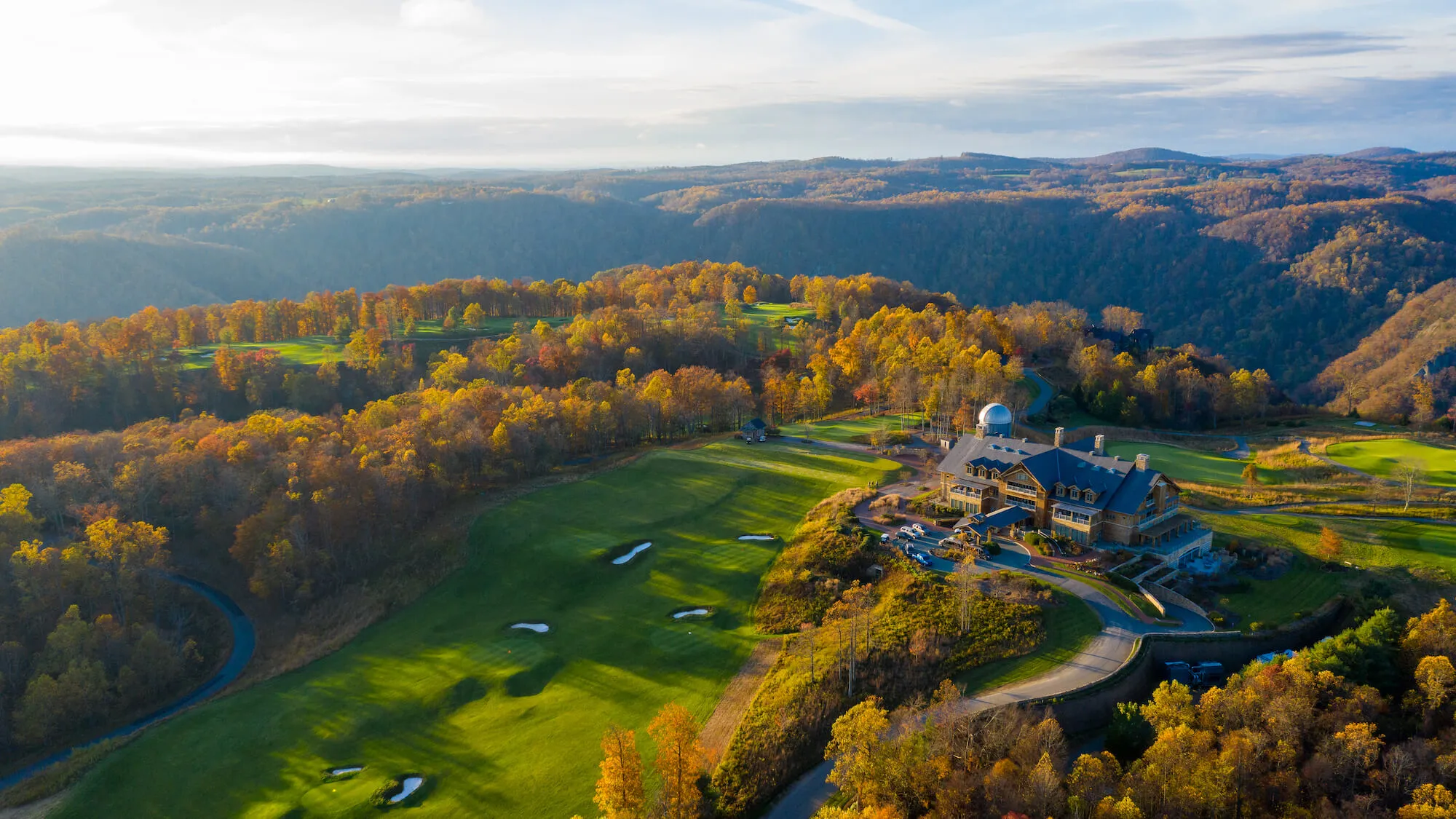
The road into Primland Resort climbs for a long time. You pass through Meadows of Dan, a quiet community in Patrick County, Virginia, and keep going until the valley floor is well below you and the tree line feels close enough to touch. The resort sits at nearly 3,000 feet on a 12,000-acre property straddling the Blue Ridge, about forty miles south of Roanoke and just north of the North Carolina line. The elevation is not incidental — it defines every experience on the property, and it is the first thing a golfer should understand about the Highland Course.
The Setting: Blue Ridge at Full Altitude
Patrick County is not a place most travel writers find their way to, which is part of why Primland still feels like a discovery. The plateau that anchors the property overlooks the Dan River Gorge and a geological curiosity the region calls the Pinnacles of the Dan — tall columns of rock that rise from the river valley below. On a clear morning, the view from certain tee boxes extends into North Carolina. On the 7th, on the right day, you can see the Winston-Salem skyline dissolving into the haze. The Blue Ridge Parkway is within reach. The whole sensibility of the place is quieter, more remote, more genuinely mountain than the resort corridors in western North Carolina or the Shenandoah Valley.
Primland is part of the Auberge Resorts Collection, which means the service infrastructure and design vocabulary are consistent with properties like Esperanza and Chileno Bay — but the landscape here is entirely its own.
The Highland Course: Donald Steel’s Mountain Routing
The Highland Course opened in 2006, designed by Donald Steel with associates Tom Mackenzie and Martin Ebert. Steel, a Scottish architect best known for his work at links courses in the British Isles, brought a routing discipline to the Blue Ridge that mountain courses often lack. Rather than forcing holes straight up and down the fall lines — the easy, repetitive pattern that makes so many mountain tracks feel like cardio more than golf — Steel found the ridges, the plateaus, and the natural saddles in the terrain and built along them. The result is an 18-hole, par-72 layout at 7,053 yards from the tips, with elevation changes that are dramatic but rarely punishing.
The greens are large by any standard, which is partly a compensation for the thinness of air at altitude (the ball flies a club or more longer than at sea level) and partly a function of Steel’s willingness to let the putting surfaces run with the natural contour of the land. Fairways are generous. The danger is not in narrow corridors but in the hillsides themselves — miss wide and the ball is often gone, swallowed by native fescue and gravity.
The Holes Worth Knowing
Primland’s first hole is as good an opener as the state of Virginia has to offer: a 536-yard par 5 that flows downhill between rock formations toward an infinity-edge green with the Pinnacles of the Dan framed behind it. The strategic options off the tee and into the green are real, not cosmetic, and the view from that approach shot — across the ravine, to the tree-covered mountain on the far side — is the kind of image that survives the trip home.
The par-3 2nd is the hole most reviews land on as the course’s best single experience: a long iron or hybrid to a large, receptive green that breaks back to front, with mountain exposure on three sides. The downhill par-3 8th earns its own partisans. The 13th green, a triple-plateau with views that open behind it, rewards the approach shot and punishes anyone who ignores the slope. The 18th delivers the kind of closing theater that earns the journey: a spectacular vista from the tee, a demanding approach, and the Lodge in the background as the round closes.
Steel found the ridges and the natural saddles in the terrain and built along them — the result is an 18-hole layout where the elevation is dramatic but never gratuitous.
Golf Digest and Golfweek both rank the Highland Course No. 1 in Virginia. Golfweek has also placed it among its top resort courses nationally. These rankings reflect the course’s consistency: there are no weak stretches, no filler holes squeezed in to reach 18.
The Rest of the Property
Primland’s lodging divides into several types. The Lodge holds the main rooms and suites — stone-and-timber construction, mountain views, the full resort infrastructure. Spread across the property are Pinnacle Cottages, Tree Houses perched above the Dan River Gorge, and larger Mountain Homes for parties that want private living space. The Tree Houses in particular appeal to guests who want the resort’s services without the lodge’s density.
The resort’s observatory is one of the more unusual amenities in American golf travel. The program begins with an outdoor constellation and planet walk, then moves to a Celestron 14” telescope for a presentation on stellar evolution. At nearly 3,000 feet with minimal light pollution, the sky on a clear Blue Ridge night is worth staying up for.
- Fly fishing — the Dan River and its tributaries run through the property; guided half- and full-day trips are available on-site.
- Horseback riding — guided rides through old-growth forest on the property’s trail network.
- Wingshooting — sporting clays and wingshooting programs that draw their own dedicated following, separate from the golf clientele.
- Spa and wellness — indoor pool, hot tub, fitness center, and a full treatment menu in the wellbeing retreat.
- Observatory — nightly astronomy program; advance reservation recommended.
Dining centers on the Lodge’s main restaurant, which sources regionally and reflects the seasons with reasonable seriousness. There is a proper bar, the kind of room you want to sit in after a mountain round when the light is going gold and the air has cooled.
How to Play It
The Highland Course is a resort course, which means access is tied to a stay at Primland. Every overnight reservation includes a round of golf for one person — the default structure for resort guests. Additional rounds are bookable on top of that, and the resort also offers annual golf memberships for guests who make Primland a regular destination. There are no external tee times for non-guests or non-members; the exclusivity is structural rather than ceremonial, and it keeps the pace of play and the experience consistent.
The drive from Roanoke is roughly forty minutes. Charlotte is about two hours. The Washington, D.C. area is closer to four. Most guests fly into Roanoke-Blacksburg Regional (ROA), rent a car, and commit to the climb. The resort can arrange transportation. Helicopter access exists for those who plan ahead.
What It Means for How You Travel
Primland is not a destination you combine with other golf stops on the same trip. The property is self-contained by design and by geography — you go there, stay, play, and let the altitude and the landscape do what they do. For the golfer who wants to anchor a mid-Atlantic trip around a single course that delivers both quality and setting, it is the clearest answer in the region.
The members who travel through LXV understand the difference between a course that is merely difficult and one that is genuinely worth the effort. Primland is the latter: a course whose best holes stay with you, on a property whose quietness is not a liability but the point.
Keep reading
- The Golf Courses Worth Building a Life Around
- The Broadmoor: Golf, History, and How to Play Colorado’s Grande Dame
- How to Play Pebble Beach: Tee Times, Cost, and Access in 2026
One network, dozens of destinations. Primland is the kind of property LXV members reach through a single membership — alongside reciprocal access to the world’s most exclusive private clubs. Apply for membership →