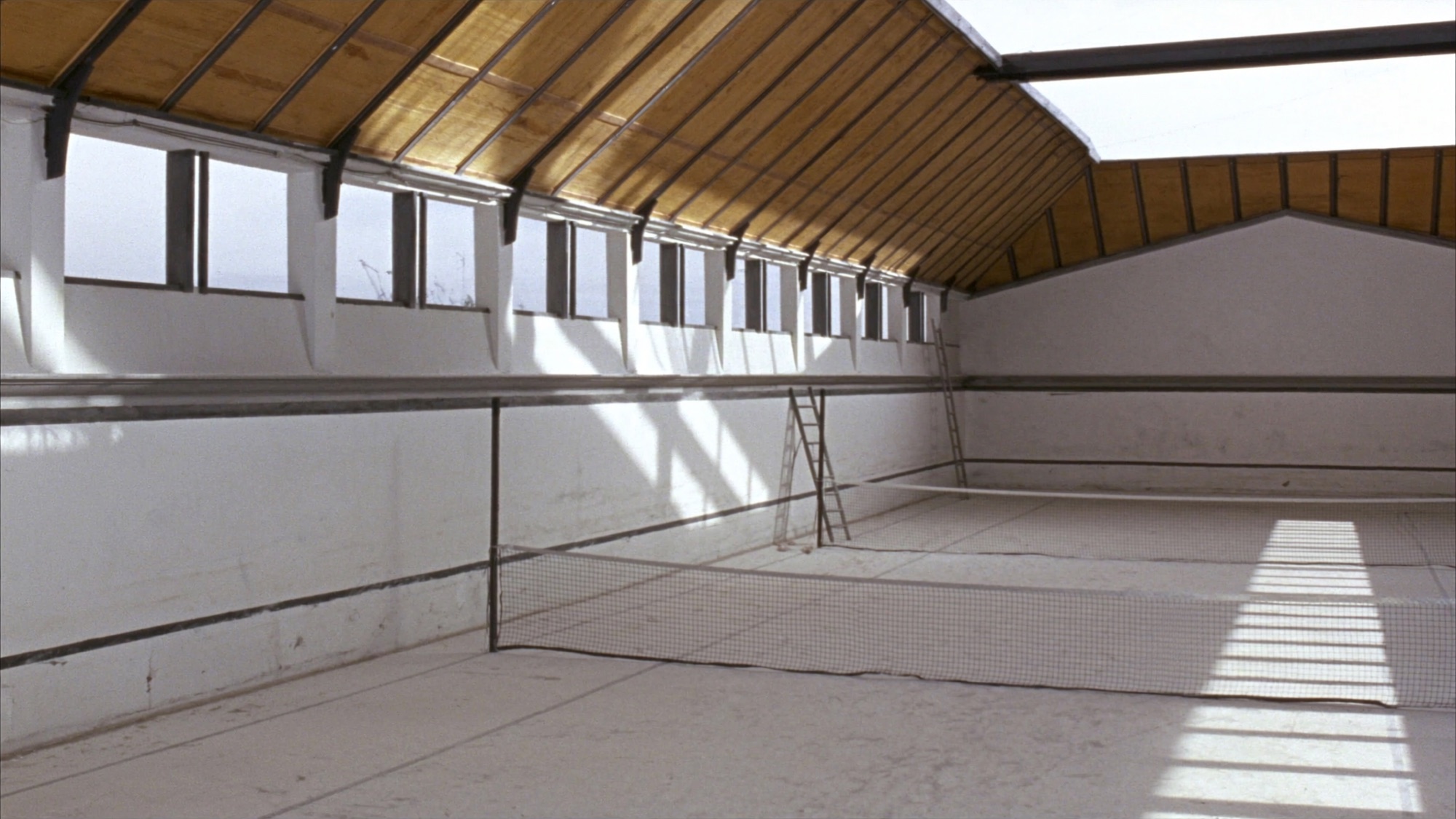
Henry VIII’s second wife was watching a game of tennis at Whitehall on the afternoon of May 2, 1536, when the men came for her. She was taken to the Tower that evening. According to the same accounts, when the news of Anne Boleyn’s execution reached the king seventeen days later, he was reportedly on a tennis court himself. The story gets told with more flourish than that in most retellings — gambling debts, unclaimed winnings, a king who barely looked up from his serve. The verifiable version is plainer, and stranger for being plainer: this was not lawn tennis, and there was no lawn. It was a game played inside a walled room with sloping roofs down two sides, a net that dipped in the middle, and a scoring system four hundred years old that modern tennis still uses without knowing where it came from.
That game — court tennis in the United States, real tennis in Britain and Ireland, royal tennis in Australia, courte-paume in France — is still played today. Not widely. There are ten courts left in the entire country, inside nine buildings, and to hit a ball on any of them you must first be let in by the members.
The Game Henry VIII Did Not Invent
The game predates Henry VIII by roughly four hundred years. Its origins trace to a handball-style game played in French monastery cloisters and courtyards from around the 12th century, played first with the bare palm — hence jeu de paume, “game of the palm” — before gloves and eventually short-handled racquets took over the striking. By the time it reached its enclosed, roofed form in the 16th century, it had become a full obsession of the French court. A Papal Legate reported roughly 250 courts operating in Paris alone near the game’s peak of popularity there, under the patronage of Francis I and his successors.
England’s royal association began earlier than Henry VIII, with Henry V, but Henry VIII is where the popular history gets loose. He is often credited with personally building the court that survives today at Hampton Court Palace. The more precise record, kept by Hampton Court’s own custodians, is that the court was built for Cardinal Wolsey between 1526 and 1529 and opened in 1528 — the same year Wolsey’s grip on Hampton Court, and on Henry’s favor, began to slip. Henry played there from 1528, whether or not he commissioned it, and by the time Wolsey fell from power in 1529 the palace and its tennis court belonged to the king outright. That Hampton Court survives at all, still in active use by a real tennis club today, is remarkable. Whether “Henry VIII built it” is quite the right sentence is a separate question, and the sources genuinely disagree on it.
They disagree on an even bigger claim, too: the world’s oldest surviving court. James V of Scotland had a court built at Falkland Palace, with construction beginning in 1539 and finishing in 1541 — a full decade after Hampton Court opened. Falkland’s own historians call it the oldest tennis court still in use today, a claim that rests on Falkland having never been substantially rebuilt, while Hampton Court’s has been renovated more than once (most notably in 1660 and 1975). Other assessments rank Falkland second-oldest among the world’s roughly four dozen active courts rather than first. Nobody disputes that both are genuinely five centuries old. Which one gets to say “oldest” depends on what you mean by the word, and the sport’s own historians have never fully agreed.
A Court Built Before Anyone Standardized Anything
Real tennis is played in what is technically called a jeu à dedans court — a rectangular room, roughly the footprint of a badminton hall, but with no two walls alike. Three of the four walls carry a sloping wooden roof, called a penthouse, pitched between roughly two and 2.2 meters above the floor; the fourth is the flat “main wall.” Jutting from the main wall is the tambour, an angled buttress of wood set at roughly 53 degrees that deflects the ball unpredictably toward the receiver — the single feature most responsible for making the game look, to a modern eye, like nobody designed it on purpose. Beneath the penthouses are a series of openings: the dedans, a roughly six-meter-wide gallery behind the server where spectators sit and where a ball struck into it wins the point outright; the grille, a small square opening barely a meter across, tucked beside the tambour, that does the same. Balls are still handmade: a cork core wound tightly in string and fabric tape, finished in a hand-sewn jacket of woven wool, weighing about a third more than a modern lawn tennis ball and bouncing considerably less. Racquets are short, wooden, and lopsided — asymmetric, oval-headed, strung tight enough to control a heavier ball, with a sweet spot so small that professionals still string their own.
The scoring — love, 15, 30, 40, deuce — is the direct ancestor of lawn tennis scoring, borrowed wholesale when lawn tennis was invented in the 1870s. What lawn tennis didn’t borrow is the chase, and the chase is the reason this game has no real modern equivalent. In lawn tennis, a ball that bounces twice simply ends the point. In real tennis, if a player fails to return a shot before it bounces twice, the point is not automatically lost — instead, a “chase” is marked, noted by exactly where on the floor that second bounce landed, measured against a series of lines running the length of the court. Play continues on an entirely different point. The chase is only settled later — when the score reaches game point, or when a second chase has been laid, whichever comes first — at which point the players swap ends of the court and replay that specific chase as its own point, with the returning player required to land their reply closer to the back wall than the original chase mark. It is, in effect, a wager laid mid-rally and cashed in later, sometimes minutes afterward, sometimes in a different game entirely. No other major sport asks players to remember a debt and repay it under reversed terms on a delay. It rewards a kind of tactical patience that has no lawn tennis analogue at all.
Ten Courts, Nine Clubs, One Country
Here is the number that makes this worth writing about. As of the United States Court Tennis Association’s own current club directory, there are nine institutions in the entire country with a working court tennis court, and ten courts among them, because the Racquet and Tennis Club in New York carries two. The other eight: Aiken Tennis Club in Aiken, South Carolina; the Tennis and Racquet Club in Boston; the Racquet Club of Chicago; the National Tennis Club at the International Tennis Hall of Fame in Newport, Rhode Island; the Racquet Club of Philadelphia; the Tuxedo Club in Tuxedo Park, New York; Westwood Country Club in Vienna, Virginia (the Washington-area club’s court, previously housed in McLean, Virginia, before Westwood’s Prince’s Court opened in 2022); and Georgian Court University in Lakewood, New Jersey — the sole non-private-club exception, a court built in 1899 for a Gilded Age estate that the university now maintains and makes available through arrangement, not open enrollment. Every other court on that list sits inside a members-only club. The Racquet and Tennis Club’s two courts, per the sport’s own governing bodies, are listed as being in “restricted use” — available, but only through the club.
Worldwide, there are roughly 45 active courts left: 28 in Britain, 10 in the United States, and the remainder split between Australia and France, plus a handful of related trinquet courts in southwest France that play a cousin game. Governance runs on a small, almost quaint structure to match: the International Real Tennis Professionals Association coordinates the sport’s roughly 40-odd clubs worldwide, with a national body in each of the four “tennis-playing countries” — the USCTA here, the Tennis and Rackets Association in Britain, similar bodies in Australia and France — that run their own national Opens and feed players into a biennial World Championship. It is a governance structure built for a sport with a few dozen clubs on the entire planet, because that is precisely what it has.
What Lawn Tennis Looked Like Before It Let Everybody In
There is no court tennis tour. There is no meaningful prize money — the sport’s marquee events, the national Opens and the World Championship, are contested largely by amateurs and a small population of touring professionals who make their living teaching at the same nine clubs they occasionally play in. There is no broadcast deal, no ranking system that means anything outside the sport itself, no path from a public court to a professional one, because there are no public courts. Every one of the roughly 40 clubs on earth that has a court is privately controlled, and in the United States, every one but a single university arrangement is a private club with a membership process. Talent alone gets a player nowhere in this sport. Access does the entire job that talent does everywhere else.
This is what the game modern tennis descended from actually looked like before it opened its gates — before rackets got cheap, before public parks got courts, before “lawn tennis” dropped the “lawn” and became simply tennis, played by whoever could afford a racquet and find a fence. Court tennis never made that trade. It kept its scoring system, kept its chase, kept its nine buildings, and kept the door closed. The 2026 US Open runs at Flushing Meadows from August 23 through September 13 — a fortnight in which several hundred thousand people will watch the sport that court tennis fathered, played in a stadium built to hold as many spectators as will pay for a seat. The game that raised it is still being played, this month, on ten courts, in front of the same few hundred people who always could.