The 2026 US Open runs from qualifying and Fan Week on August 23 through the final on September 13, all of it at the Billie Jean King National Tennis Center in Flushing Meadows, Queens. Roughly a mile and a half south of Arthur Ashe Stadium sits the West Side Tennis Club, the low brick complex that hosted the tournament — then called the U.S. National Championships — for sixty editions before the USTA outgrew it and moved three miles north in 1978. Most spectators who make that pilgrimage never learn the older club exists. Fewer still learn what surrounds it.
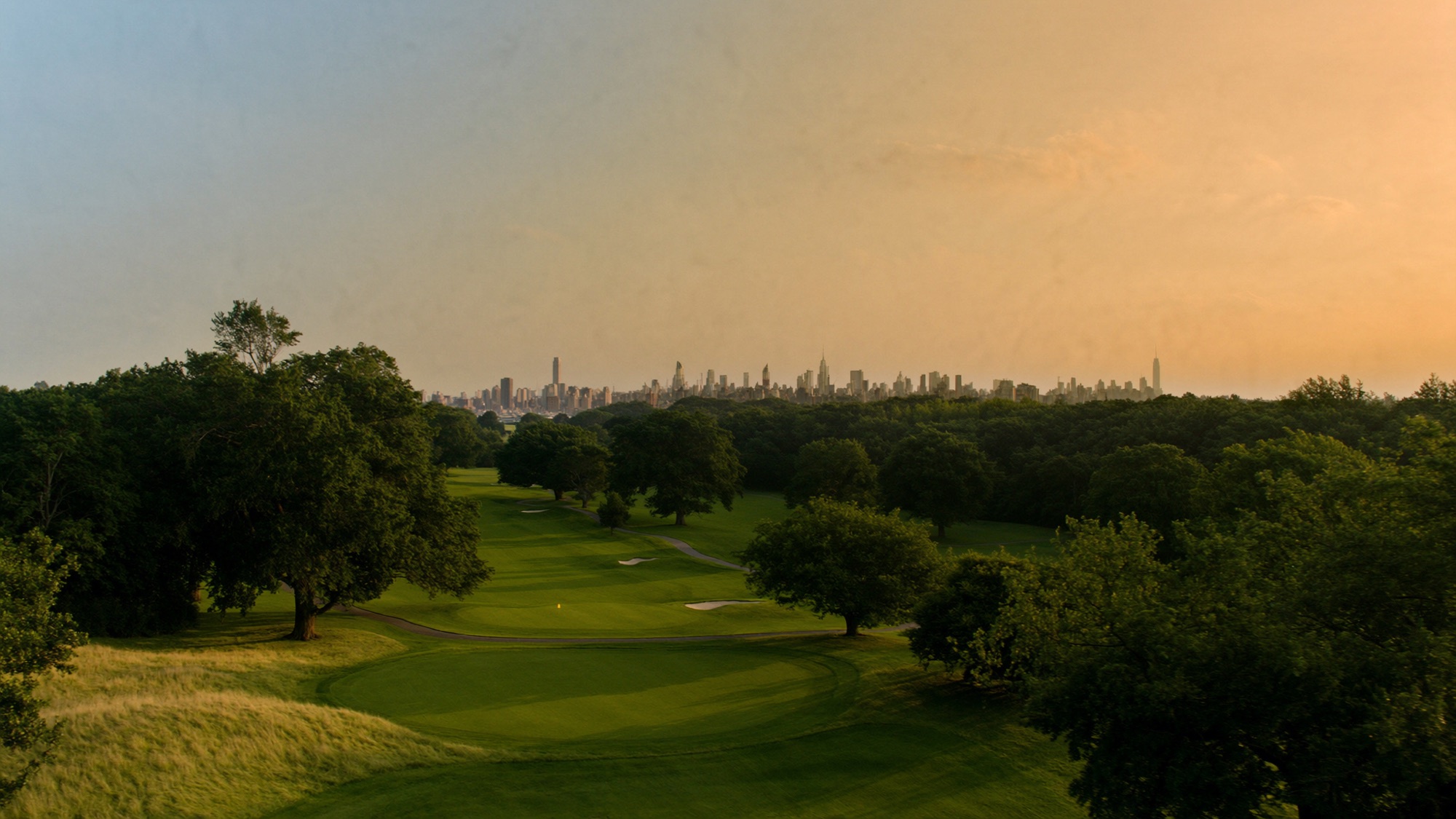
Within roughly an hour’s drive of Flushing Meadows — traffic permitting, and in late August it frequently does not — sits one of the densest concentrations of private golf clubs anywhere in the world. Long Island’s North Shore alone accounts for a meaningful share of America’s major-championship golf history. Westchester and northern New Jersey account for most of the rest. None of it is programmed around the tennis. None of it particularly cares that the tennis is happening. That is, in a sense, the point.
West Side Tennis Club — Forest Hills, Queens
Founded in 1892, the West Side Tennis Club hosted the U.S. National Championships from 1915 to 1977, with a short break in the early 1920s, before the USTA relocated the event to the newly built National Tennis Center in Flushing Meadows in 1978. Its 14,000-seat horseshoe, Forest Hills Stadium, sat derelict for decades before reopening as a concert venue in 2013 following a multi-year renovation. The club itself never closed — it still operates 38 courts across grass, clay, and hard surfaces, a working private tennis club two miles from the tournament that replaced it. Drive time from Flushing Meadows: 10 to 15 minutes off-peak, longer during Open week when the Grand Central Parkway backs up toward LaGuardia.
Bethpage Black — Farmingdale, Long Island
Bethpage Black is the one course on this list anyone can actually play. Designed by A.W. Tillinghast and opened in 1936, it is owned and operated by New York State Parks within Bethpage State Park, on the Nassau–Suffolk county line. It became the first publicly owned course to host a U.S. Open, in 2002, and hosted again in 2009, the 2019 PGA Championship, and the 2025 Ryder Cup. Tee times are notoriously difficult to secure through the state’s own booking system, and the course’s line-up culture — golfers sleeping in their cars for a weekend slot — is part of its identity. It is roughly 35 to 45 minutes from Flushing Meadows via the Long Island Expressway off-peak; during US Open week, closer to an hour.
Garden City Golf Club — Garden City, Long Island
Garden City Golf Club traces to 1899, laid out originally by Devereux Emmet and substantially reworked by member Walter Travis, who finished runner-up in the club’s own 1902 U.S. Open. It remains one of the very few men-only golf clubs still operating in the United States. The club has hosted the U.S. Amateur four times and the 1924 Walker Cup, and Golf Magazine ranked its course 26th among America’s top 100 in 2013. Access is by member introduction only, and the club does not maintain any public-facing booking channel. About 25 to 30 minutes from Flushing Meadows in ordinary traffic.
Piping Rock Club — Locust Valley, Long Island
Piping Rock, founded in 1911 on the North Shore’s Gold Coast, was built as a multi-sport estate club from the start: an 18-hole course laid out by Charles Blair Macdonald, plus polo fields, grass and clay tennis, squash, and a beach and pool complex on Long Island Sound. The clubhouse, designed by Guy Lowell in a colonial-revival idiom, has hosted the kind of membership roster — finance, publishing, old New York society — that made the Gold Coast a shorthand for a particular stratum of American wealth. It is private and admits by sponsorship; there is no public inquiry path. Roughly 40 to 50 minutes from Flushing Meadows.
The Creek Club — Locust Valley, Long Island
The Creek, designed by Charles Blair Macdonald and built in 1925 on Long Island Sound, is among the most architecturally admired — and most closed — clubs in American golf. It draws a membership overlapping with The Creek’s Gold Coast neighbors, and its waterfront setting, with several holes running along the Sound itself, is part of what separates it from the area’s other Macdonald and Raynor courses. There is essentially no route to visibility here beyond a member’s invitation; the club does not engage with press or public inquiries in any routine way. About 45 to 50 minutes from Flushing Meadows off-peak.
Fresh Meadow Country Club — Lake Success, Long Island
Fresh Meadow is the club with the most literal connection to the tournament that gives this piece its premise. Founded in 1923 in the Fresh Meadows section of northeast Queens — a few miles from where Arthur Ashe Stadium now stands — the club sold its original property in 1946 under development and tax pressure and relocated roughly five miles northeast to Lake Success, where it bought the grounds of the defunct Lakeville Golf & Country Club. The current course was laid out by Charles Hugh Alison, working with Harry Colt; the original Queens course had been an A.W. Tillinghast design. The old site is now a residential neighborhood. It is private, member-sponsored, and about 15 to 20 minutes from Flushing Meadows — closer than almost anything else on this list, geographically, to a place it once was.
Winged Foot Golf Club — Mamaroneck, Westchester
Winged Foot needs the least introduction and offers the least access. Opened in 1923 to an A.W. Tillinghast design across two courses, East and West, it has hosted the U.S. Open six times — 1929, 1959, 1974, 1984, 2006, and 2020 — plus the 1997 PGA Championship. The West Course was named a National Historic Landmark in 2024. Membership is by invitation from within, with no meaningful side door for outside golfers regardless of handicap or reputation. It sits roughly 40 to 50 minutes from Flushing Meadows via the Whitestone Bridge and Hutchinson River Parkway in ordinary traffic — both routes that August tournament congestion reliably punishes.
Quaker Ridge Golf Club — Scarsdale, Westchester
Quaker Ridge, another Tillinghast design, dates to 1916 and carries a specific founding story: it was established by wealthy Jewish businessmen whose applications to other area clubs had been rejected, built deliberately to match — architecturally and competitively — the gentile clubs that excluded them. It has hosted the Walker Cup (1997) and Curtis Cup (2018) rather than a men’s major, and is frequently cited among the best American courses never to have hosted one. Access runs through membership and guest privileges only. About 40 to 50 minutes from Flushing Meadows.
Sleepy Hollow Country Club — Briarcliff Manor, Westchester
Sleepy Hollow’s clubhouse is Woodlea, a Gilded Age mansion built in 1892–95 for Elliott Fitch Shepard and his wife, Margaret Louisa Vanderbilt Shepard, later purchased by Frank Vanderlip and William Rockefeller, who founded the country club on the estate around 1911. The property sits on the Hudson River in Scarborough-on-Hudson, with the mansion’s west facade facing the water directly. The club currently carries roughly 570 members and remains entirely private. It is the furthest north of the Westchester clubs here, around 55 to 65 minutes from Flushing Meadows off-peak — an hour that late-August traffic on I-287 and the Saw Mill River Parkway routinely erases.
Baltusrol Golf Club — Springfield, New Jersey
Baltusrol has hosted the U.S. Open seven times — 1903, 1915, 1936, 1954, 1967, 1980, and 1993 — plus the PGA Championship in 2005 and 2016, across its Tillinghast-designed Upper and Lower courses. Founded in 1895 and named for Baltus Roll, a local farmer murdered on the property decades before the club existed, it is a National Historic Landmark. In 1985 it became the first club to have hosted both the men’s and women’s U.S. Open on two different courses at the same facility. It is private and sponsor-only. Getting there from Flushing Meadows means crossing into New Jersey, typically via the Verrazzano-Narrows or the George Washington Bridge — call it 50 to 60 minutes off-peak, considerably longer with Open-week traffic layered onto ordinary bridge congestion.
Ridgewood Country Club — Paramus, New Jersey
Ridgewood, in Bergen County, traces to 1890, with its current 27-hole Tillinghast layout dating to 1929 and a clubhouse by Clifford Wendehack. Gil Hanse and Jim Wagner restored the course to closer to its original specifications beginning in 2000. The club hosted the 1935 Ryder Cup and the 2022 U.S. Amateur, and it is listed on the National Register of Historic Places. Byron Nelson worked there as an assistant professional in the mid-1930s. Access is private and member-introduced. About 45 to 55 minutes from Flushing Meadows in normal traffic.
Plainfield Country Club — Edison, New Jersey
Plainfield began in 1890 as the Hillside Tennis Club before adding golf; the current Donald Ross course opened in 1921 and was renovated by Gil Hanse and Jim Wagner in 1999. It hosted the 1978 U.S. Amateur, the 1987 U.S. Women’s Open, and The Barclays — the first FedEx Cup playoff event on the PGA Tour — in 2011 and 2015. A member, Leighton Calkins, devised the handicap system still in use across American golf in 1904. It is private, and the furthest-flung club on this list: 55 to 70 minutes from Flushing Meadows off-peak, well over the stated hour once the Turnpike and Garden State Parkway are carrying tournament traffic alongside their usual load.
Every one of these figures assumes conditions that will not exist for most of the tournament’s fortnight. Late-August New York adds construction, Yankees and Mets homestands, LaGuardia arrivals traffic funneling past the tennis center itself, and the ordinary end-of-summer volume on the Long Island Expressway, the Hutchinson, and the New Jersey approaches. Treat “an hour” as a description of distance, not of travel time during the tournament.
The pattern across all twelve is the same: the closer a club sits to Flushing Meadows, geographically, the less interested it has historically been in what happens there. West Side Tennis Club gave the tournament up entirely. Fresh Meadow moved rather than watch its old neighborhood change around it. Bethpage is the exception precisely because the state, not a membership, decides who plays it.
What a Ticket to the Tennis Actually Buys
A ticket to Ashe Stadium buys two weeks of tennis and, for most visitors, nothing else — a hotel room, a subway ride, a concession-stand dinner. It does not buy a way into Winged Foot, Baltusrol, or The Creek, and nothing published here should be read as implying otherwise. Bethpage is the one course on this list that will take your money and your tee time request; the rest will not take a call from a stranger regardless of the stranger’s handicap, net worth, or itinerary.
That is, in the end, the more interesting story than the one happening on court. The tennis draws thousands of people to New York for a fixed two weeks. The clubs around it are not performing for that audience — they are hosting the same members, the same closed rooms, the same institutional continuity they host in April and November. The tournament is the reason to come. The fortnight, and the density of consequential rooms operating quietly around it, is the actual opportunity — and the only way into most of them runs through someone already inside, which is closer to how LXV works than to how a ticket does.