The Trophy Left in 1978
For fifty-six of the sixty-three years it staged the U.S. National Championship — the tournament that became the US Open — the West Side Tennis Club was the tournament’s home. In 1978 it stopped being that. The USTA moved the Open eleven miles east to a new, larger complex at Flushing Meadows, chasing television revenue and parking that a private club wedged into a Queens garden suburb could never supply. The companion piece to this one, The US Open Is the Only Slam Not Played at a Private Club, tells that story properly — Slew Hester, the USTA board, the four majors’ diverging paths on governance.
This is not that story. This is what happened to the club afterward, because the afterward is the more interesting fact.
A Tudor Clubhouse and a Horseshoe of Concrete
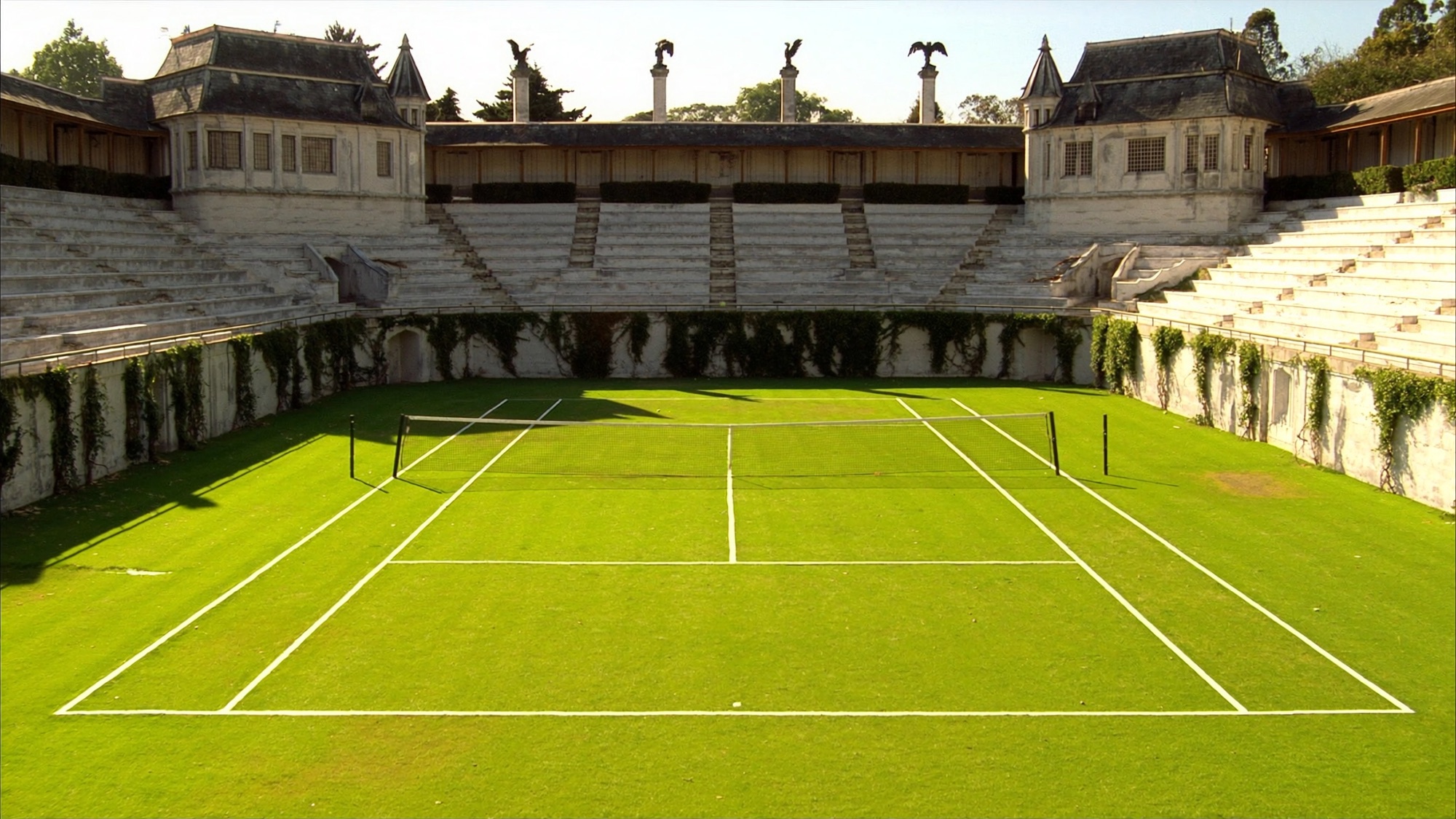
The West Side Tennis Club was founded in 1892, when thirteen members rented three clay courts on Central Park West. It outgrew Manhattan, as clubs with real ambitions on cheap, plentiful land tend to do, and in 1912 the club bought a site in the newly platted neighborhood of Forest Hills, Queens. The Tudor-style clubhouse went up the following year. By 1915 the club was hosting the U.S. National Championship, and the crowds it drew — for the 1911 Davis Cup, and later for the box-office draw of Bill Tilden — outgrew the temporary bleachers fast enough that by 1923 the club had built a 14,000-seat horseshoe-shaped concrete stadium to hold them. It still stands.
The clubhouse and stadium sit inside Forest Hills Gardens, which is worth its own paragraph and rarely gets one outside architecture syllabi. Margaret Olivia Sage, widow of the financier Russell Sage and founder of the Russell Sage Foundation, bought 142 acres from the Cord Meyer Development Company in 1908 and commissioned the architect Grosvenor Atterbury, working with the landscape firm descended from Frederick Law Olmsted’s practice, to build a planned community explicitly modeled on Ebenezer Howard’s garden city movement — the same idea behind England’s Letchworth, begun five years earlier. The result is several hundred acres of Tudor Revival stucco and Ludowici clay tile, curving streets designed to discourage through-traffic, and some of the earliest prefabricated precast-concrete residential construction in the country. It is a private, deed-restricted community that predates the club’s stadium by fifteen years and has quietly outlasted every argument about what the tennis club is for. The Church-in-the-Gardens and the neighborhood’s post office are both on the National Register of Historic Places. The stadium, notably, is not — the New York City Landmarks Preservation Commission declined to designate it in 2011, when press coverage was calling it a crumbling ruin.
What the Club Still Has
Most American tennis clubs that once had grass courts do not have them anymore. Grass is expensive, slow to recover, unforgiving of rain, and abandoned by nearly every major tournament outside the United Kingdom — Wimbledon has been the only Grand Slam played on it since 1988. The West Side Tennis Club has not abandoned it. The club currently maintains 38 courts across all four competitive surfaces — clay, Har-Tru, hardcourt, and grass — a spread that puts it in a category by itself among private clubs in the country. [Note: a precise count of grass courts specifically was not confirmed against a citable source and is not asserted below.]
The credentials attached to those courts are real. West Side hosted more Davis Cup finals — ten — than any other venue in the sport’s history, along with eleven U.S. Pro Championships and three Tournaments of Champions. A 2016 attempt to give the club a second act as a professional venue — World TeamTennis’s New York Empire played its inaugural season there — lasted one year before the team relocated to the USTA’s Flushing Meadows complex in 2017. The lesson, evidently, was not lost on anyone: West Side’s future was not going to be built on competing with the tournament that left.
The Heart of It: A Stadium That Became a Concert Hall
The Beatles played Forest Hills Stadium on August 28 and 29, 1964, drawing more than 31,000 fans across the two nights — still, by the venue’s own account, an attendance record for the site. Stevie Wonder opened. The band arrived by helicopter after landing at Kennedy at 3 a.m., and each 15,983-seat show ran a scant sixty-three minutes into a wall of screaming that made the music close to irrelevant.
The stadium’s stranger, more consequential night came almost exactly a year later. On August 18, 1965, weeks after his amplified set at Newport had split the folk world in half, Bob Dylan returned to Forest Hills and did it again on purpose: an acoustic first set, then a return with the musicians who would become The Hawks, plugged in. Some of the crowd booed through the electric half. It did not matter. The template — folk hero turns rock star in front of an audience that has not agreed to the change — was set at Forest Hills as much as it was at Newport.
The Rolling Stones played the stadium in 1966, on their fifth North American tour, with Brian Jones reportedly asking the crowd to stop throwing lipstick tubes at his head. In 1967, Jimi Hendrix opened for The Monkees — a booking mismatch so complete that a teenage crowd expecting bubblegum pop rejected him outright; Hendrix left the stage mid-tour with an obscene gesture and asked to be released from the contract. The Forest Hills Music Festival that hosted these shows ran from 1961 to 1971, also bringing through Ray Charles, Diana Ross and the Supremes, Simon & Garfunkel, Frank Sinatra, and Barbra Streisand.
Then it stopped. The tennis left in 1978, the music thinned out through the 1980s, and Forest Hills Stadium sat for more than three decades doing very little of anything, its concrete cracking, its seats stripped or rotting, ivy where a Grand Slam used to be played. It took until August 28, 2013 — a near-exact 49-year anniversary of the Beatles’ first night — for the venue to reopen as a concert hall, with a sold-out Mumford & Sons show. A four-year renovation followed: patched exterior walls, 1,200 new seats added in 2014, a permanent stage designed by Mark Fisher, the set designer behind productions for Pink Floyd, U2, and — fittingly — the Rolling Stones. The stadium now runs a full summer concert season under Bowery Presents, the AEG-owned promoter, with capacity in the neighborhood of the venue’s historic 15,983-seat figure depending on configuration.
A Private Club With a Very Public Backyard
This is the tension that makes Forest Hills worth writing about, and it has not been resolved so much as litigated. The stadium sits inside a residential enclave governed by the Forest Hills Gardens Corporation, a private entity that controls the surrounding streets — streets the city needs closed for concert crowds and security. The club does not simply throw concerts; it negotiates for the right to, every season, with its own neighbors.
The friction is well documented and not minor. In 2014, shows by Brand New and Modest Mouse, Zac Brown Band, and Lil Wayne exceeded the city’s decibel limits and drew warnings; a Replacements show that same year blew through the limit three times in its finale and cost the venue a $3,200 fine. In 2015 the stadium spent $500,000 on noise mitigation — a concrete fence, covered stairwells. An October 2022 show by Yeah Yeah Yeahs and Japanese Breakfast generated 62 noise complaints, a stadium record. In May 2023 the Forest Hills Gardens Corporation sued the stadium over the neighborhood’s residential zoning, and a judge had to issue an injunction just to keep Burns Street open for that summer’s more than thirty scheduled shows; the venue was sued three separate times that year over noise. In March 2025, the Gardens Corporation refused to let the NYPD close the private streets it controls and denied the stadium its summer permits outright, a standoff that was not resolved until mid-April. By 2026, the city itself had reached a $150,000 settlement with residents over the dispute.
None of this reads like a club at peace with its own real estate. It reads like a club that made a bet — that a stadium generating noise, lawsuits, and neighborhood resentment was still a better outcome than a stadium generating nothing at all — and has spent every summer since defending it.
The Lesson That Travels
What is publicly known about the club’s current membership — its size, its dues, how one joins — is not disclosed anywhere verifiable, and this piece will not guess. What is verifiable is the shape of the trade the club made. It kept its grass, its clubhouse, its Davis Cup pedigree, and thirty-eight courts across four surfaces most clubs cannot maintain even one of. It gave up sole use of its own backyard to Bowery Presents, AEG, and forty thousand strangers a summer, and it fights its own neighbors over the noise those strangers make.
Most private clubs facing the loss of the thing that defined them try to protect what is left of the original purpose — tighten the membership, guard the tradition, wait for relevance to return. Forest Hills did the opposite. It let the stadium become something its 1923 founders would not have recognized, would very possibly not have approved of, and that decision — not the grass courts, not the Tudor clubhouse — is the actual reason the West Side Tennis Club still exists in 2026 instead of existing only in US Open trivia.