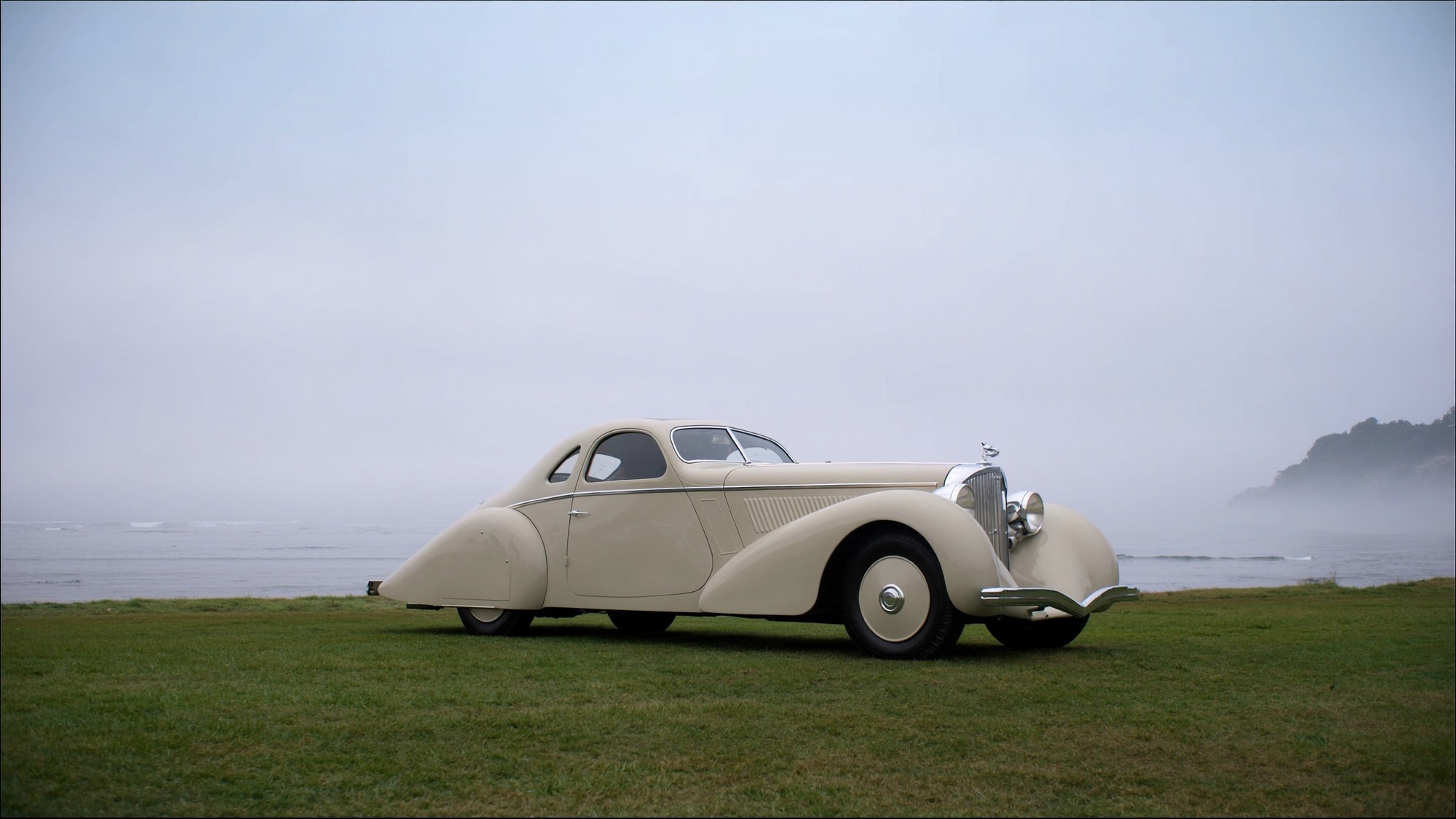
Best of Show — What 25 Years of Pebble Beach Winners Reveal
On the 18th fairway at Pebble Beach, a jury of roughly 100 people spends a Sunday morning walking past several hundred million dollars of pre-war automobiles, and by mid-afternoon they have reduced the field to one. Since 1950 they have done this 74 times. The ceremony has never been open to a popular vote, a gate-vote, or an applause-o-meter. It is judges only — and on August 16, 2026, they will do it for the 75th time.
The 25 years from 2000 to 2025 offer a large enough sample to see what the jury actually rewards, rather than what a car show is generally assumed to reward. It is not horsepower, not fame, not the biggest name on the badge. It is something closer to provenance and rarity as judged by people who have spent their lives acquiring both. Read as data, the winners list stops looking like a leaderboard of great cars and starts looking like a log of who has been let into a room.
The Field: Verified Winners, 2000–2025
Every entry below has been checked against the Pebble Beach Concours d’Elegance’s own historical winners page and cross-referenced against period reporting — Car and Driver, The New York Times, Autoweek, Motor Trend, Forbes, and Hagerty among them — or, for years without full contemporaneous coverage in this research pass, against Wikipedia’s citation-backed winners table. No entry here rests on a single source. The 2020 concours was cancelled due to the pandemic; there was no Best of Show that year, which is why the table below shows 24 winners across 26 calendar years.
| Year | Car | Coachbuilder | Owner |
|---|---|---|---|
| 2000 | 1937 Delahaye 135 M Cabriolet | Figoni & Falaschi | Jacques & Betty Harguindeguy |
| 2001 | 1930 Mercedes-Benz SS Roadster | Erdmann & Rossi | Arturo & Deborah Keller |
| 2002 | 1934 Voisin C-15 Roadster | Saliot | Sam & Emily Mann |
| 2003 | 1936 Bugatti Type 57SC Atlantic | (in-house Bugatti) | Peter D. Williamson |
| 2004 | 1938 Horch 853A Sport Cabriolet | Erdmann & Rossi | Joseph & Margie Cassini III |
| 2005 | 1937 Delage D8-120 S Aero Coupe | Pourtout | Sam & Emily Mann |
| 2006 | 1931 Daimler Double-Six 50 Drophead Coupe | Corsica | Robert M. Lee |
| 2007 | 1935 Duesenberg SJ “Mormon Meteor” Speedster | (custom/factory) | Harry Yeaggy |
| 2008 | 1938 Alfa Romeo 8C 2900B Berlinetta | Touring | Jon & Mary Shirley |
| 2009 | 1937 Horch 853 Sport Cabriolet | Voll & Ruhrbeck | Robert M. Lee |
| 2010 | 1933 Delage D8 S Roadster | de Villars | Jim Patterson / Patterson Collection |
| 2011 | 1934 Voisin C-25 Aerodyne | (in-house Voisin) | Peter & Merle Mullin |
| 2012 | 1928 Mercedes-Benz 680S Torpedo | Saoutchik | Paul & Judy Andrews |
| 2013 | 1934 Packard 1108 Twelve Convertible Victoria | Dietrich | Joseph & Margie Cassini III |
| 2014 | 1954 Ferrari 375 MM Coupe | Scaglietti | Jon Shirley |
| 2015 | 1924 Isotta Fraschini Tipo 8A Cabriolet | Worblaufen | Jim Patterson / Patterson Collection |
| 2016 | 1936 Lancia Astura Cabriolet | Pinin Farina | Richard Mattei |
| 2017 | 1929 Mercedes-Benz S Tourer | Barker | Bruce R. McCaw |
| 2018 | 1937 Alfa Romeo 8C 2900B Berlinetta | Touring | David & Ginny Sydorick |
| 2019 | 1931 Bentley 8 Litre Sports Tourer | Gurney Nutting | Sir Michael Kadoorie |
| 2020 | — no concours held — | — | — |
| 2021 | 1938 Mercedes-Benz 540K Autobahn Kurier | (factory) | Arturo & Deborah Keller |
| 2022 | 1932 Duesenberg Model J Sports Torpedo | Figoni | Lee R. Anderson Sr. |
| 2023 | 1937 Mercedes-Benz 540K Special Roadster | (factory Sindelfingen) | Jim Patterson / Patterson Collection |
| 2024 | 1934 Bugatti Type 59 Sports | (in-house Bugatti) | Fritz Burkard / Pearl Collection |
| 2025 | 1924 Hispano-Suiza H6C Nieuport-Astra Torpedo | Nieuport-Astra | Penny & Lee R. Anderson Sr. |
Prewar Wins by Default, Not by Rule
There is no clause in the Pebble Beach rulebook that excludes postwar cars from Best of Show. There does not need to be one. Of the 24 winners between 2000 and 2025, exactly one was built after the Second World War: the 1954 Ferrari 375 MM that Jon Shirley showed in 2014, ten years after his 1938 Alfa Romeo had already won in 2008. Every other winner in a quarter-century was built between 1924 and 1938 — a fourteen-year window bracketed almost precisely by the two world wars.
This is not the jury being nostalgic. It is the jury judging what the format was built to judge. Best of Show is not a performance contest; it is a preservation-and-artistry contest, and the cars built in that narrow interwar span were designed by coachbuilders working without the constraints — crash regulation, unified body-and-chassis manufacture, cost control at scale — that would flatten automotive design into something closer to appliance-making after 1945. A 1937 car with a hand-formed aluminium body by Figoni or Touring is, in the terms this jury uses, doing something a 1954 Ferrari is not: it is one-off. Even the Ferrari’s win is instructive rather than exceptional — Scaglietti coachwork on a car built in vanishingly small numbers, which is to say a postwar car judged by prewar rules.
The American Car Problem
Three of the 24 winners were American: the Duesenberg twice (2007, 2022) and the Packard once (2013). That is 12.5 percent of the field, from a country that dominated global automobile production for most of the twentieth century. The explanation is not that American coachwork was inferior — Duesenberg’s Judkins, Murphy, and Rollston-bodied cars stand with anything Europe produced — but that America built far fewer of the ultra-bespoke, single-chassis, aristocrat-commissioned cars that the format rewards. European coachbuilders like Figoni et Falaschi, Saoutchik, and Erdmann & Rossi worked to individual commission for individual clients in a way American body shops, even the best of them, more rarely did at the same volume. Duesenberg is the exception that proves it: a marque built almost entirely on that European model, transplanted to Indiana.
The Coachbuilder Roll Call
Touring of Milan appears twice in this window — 2008 and 2018 — on the same model, the Alfa Romeo 8C 2900B Berlinetta, on two different chassis (412035 and 412020) owned by two different Californians. That is not a coincidence so much as a ceiling: there were only a handful of 8C 2900B Berlinettas built, and two of them have now separately won Best of Show. Figoni appears twice, first on a Delahaye in 2000 and again — as “Figoni” alone, the “et Falaschi” partnership having dissolved by then — on a Duesenberg in 2022. Erdmann & Rossi, Saoutchik, Pinin Farina, and Gurney Nutting each appear once. These are not incidental credit lines. A concours judge reading a dash placard sees the coachbuilder’s name before the owner’s, and in a field this specialized, the name on the body is doing as much work as the name on the title.
The Closed Circuit: Who Keeps Winning
This is the pattern that matters most, and it is the one a simple marque count obscures. Look at owners, not cars.
Jim Patterson, through the Patterson Collection, won three times in this span — 2010, 2015, and 2023. Arturo and Deborah Keller won twice — 2001 and 2021, twenty years apart, both times with a Mercedes-Benz. Joseph and Margie Cassini III won twice, in consecutive-feeling fashion, 2004 and 2013. Robert M. Lee won twice, 2006 and 2009, with two different Horch- and Daimler-bodied Erdmann & Rossi-adjacent cars. Jon Shirley won in 2008 and again, individually, in 2014. Lee R. Anderson Sr. won in 2022 and again in 2025, the second time jointly with his wife, Penny.
Six names — Patterson, Keller, Cassini, Lee, Shirley, Anderson — account for 11 of the 24 Best of Show wins between 2000 and 2025. Not 11 different collectors overlapping by coincidence. The same collectors, returning.
The names that keep appearing on the Best of Show trophy are not there because they own more cars than anyone else. They are there because the community that decides what wins has decided, repeatedly, that these are the people whose cars belong at the top. That is not a market. That is a membership.
What the Jury Actually Is
Pebble Beach’s own description of its judging process is unambiguous about the mechanism, if understated about what the mechanism implies. Cars are judged first within their class by roughly 100 Class Judges and Honorary Judges — specialists in marque history, restoration authenticity, and design — who advance the class winners to a final round. From that final round, a small voting body of Chief Class Judges, Honorary Judge team leaders, the Chief Judge, the Chief Honorary Judge, and the Chairman select the Best of Show nominees and, from among them, the winner.
None of that panel is elected by the public. None of it is elected by the entrants. It is drawn from marque historians, restoration specialists, museum curators, and — this is the part worth sitting with — past class winners and past Best of Show recipients themselves, invited back into the judging ranks in later years. The jury is, in a meaningful sense, built out of the same population that keeps winning. This is not corruption; nobody alleges vote-trading over a Delage. It is simply how expertise concentrates in any sufficiently specialized world: the only people qualified to judge a coachbuilt 1937 Talbot-Lago against a coachbuilt 1937 Horch are people who have spent decades acquiring, restoring, or writing about exactly those cars. There are perhaps a few hundred such people alive. Many of them show cars. Many of them also judge them, in other years, on other fields.
The LXV Reading
A private club does not admit members by popular vote either. It admits them by the judgment of members who already belong, applying standards that are rarely written down in full and are calibrated, year after year, by people who have themselves already been judged and passed. Pebble Beach’s Best of Show is the automotive expression of the identical mechanism: a closed panel of qualified insiders, deciding who else gets to stand at the top of a field that the outside world is permitted to watch but never to vote on.
Read the winners list again with that in mind. It stops being a catalogue of beautiful cars. It becomes a roster of the families and collections the concours world has spent 25 years agreeing belong at its summit — Patterson, Keller, Cassini, Lee, Shirley, Anderson, and the two dozen others who got there once. Access to that roster was never for sale at any price on the program. It was earned, the way it always is in a closed circuit: by being known, for a long time, to the people already inside it.