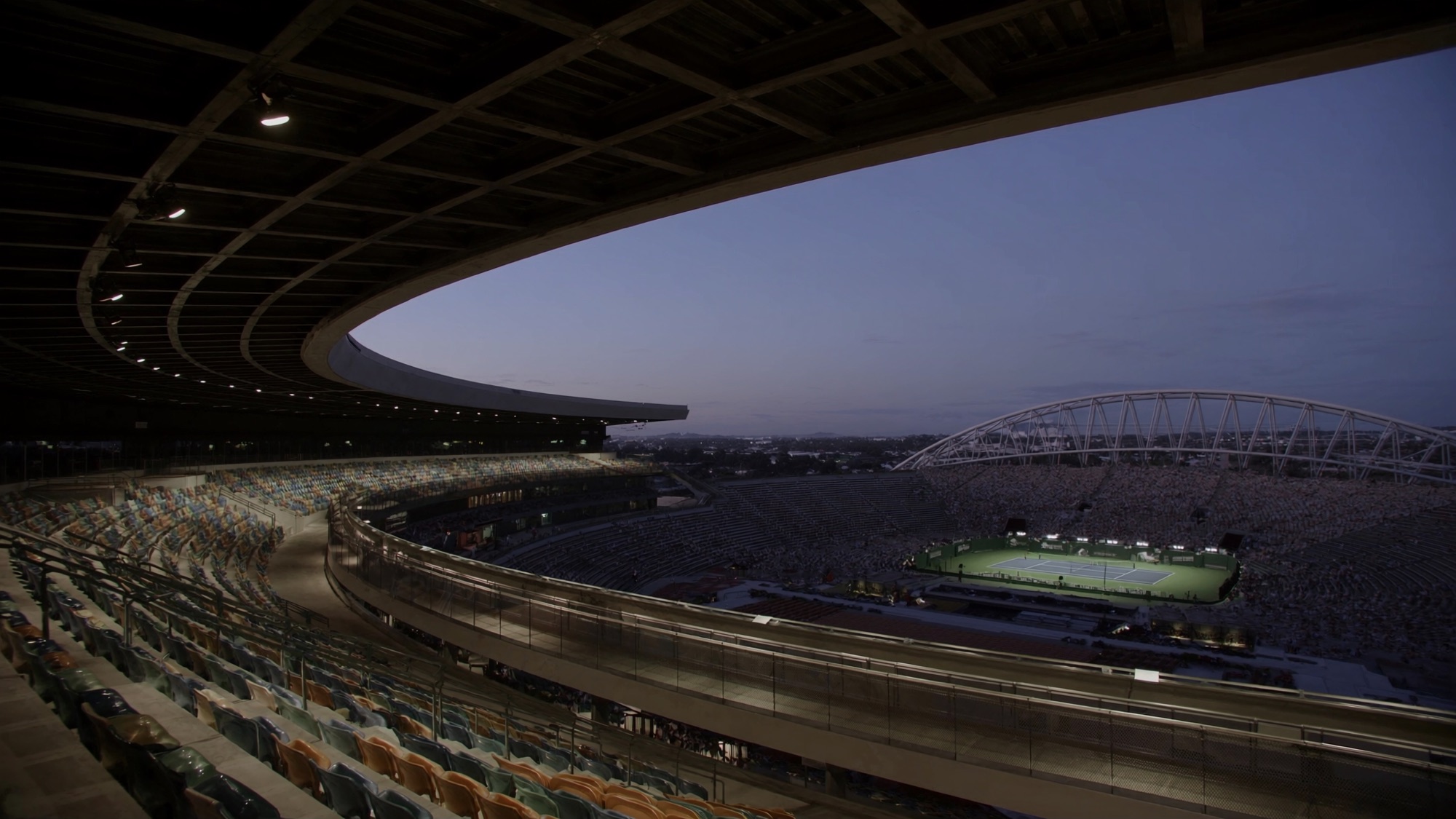
On August 23, the gates at the USTA Billie Jean King National Tennis Center open to anyone holding a free digital pass downloaded onto a phone. On September 13, roughly three weeks later, a small number of people will watch the men’s final from a seat that was never for sale at any price, at any point, to anyone. Both are the US Open. The distance between those two facts — one purchasable in thirty seconds, the other not purchasable at all — is what this ladder maps.
The 2026 tournament runs 22 days, August 23 through September 13, and is being reported by the USTA as the largest edition in the event’s near-150-year history. Figures below are current as of late July 2026; where the market prices something dynamically, that is stated rather than disguised behind a false single number.
Eight Free Days Inside a Twenty-Two-Day Tournament
Fan Week runs Sunday, August 23, through Saturday, August 29 — seven days before the main draw begins. Grounds admission during that stretch is free, though every fan 18 and older must register a free Fan Access Pass through the US Open app to get through the gate. Free admission covers the Grounds, all outer courts, and general-admission sections of Louis Armstrong Stadium; it does not cover Arthur Ashe Stadium. Arthur Ashe Kids’ Day opens the week on August 23, and mixed doubles qualifying runs a free eight-team bracket in Grandstand on August 24. Beyond Fan Week, the tournament adds a second free day mid-event: “Open for All Day” on Thursday, September 10, during quarterfinals week — the eighth day of complimentary grounds admission across the 22-day run.
This is, without much competition, the best value in American tennis, and it is badly underused. Fan Week puts you on the same practice courts as the top of the draw, days before anyone is nervous, for the cost of a phone and a subway fare.
The Grounds Pass Is the Cheapest Way to Stand Near a Champion
Once the main draw begins on August 30, grounds access becomes a paid Grounds Pass, with official box-office pricing starting around $65 for early-round days according to the tournament’s ticketing partner. It buys general-admission access to the Grounds and all outer courts, plus first-come, first-served seating in Grandstand and the general-admission sections of Louis Armstrong Stadium. It does not include Arthur Ashe Stadium at any price.
The underrated case for it is proximity, not economy. In the tournament’s first week, a meaningful share of seeded players — including some inside the top 16 — are still drawn onto courts 5, 6, 11, and 17, not Ashe. A grounds pass holder standing three rows back at Court 17 is physically closer to that match than an Ashe reserved-seat holder in an upper promenade section with a program and a pair of opera glasses. Early rounds on the outer courts are the sleeper value of the entire tournament.
Armstrong Is Where the Grounds Pass Runs Out
This is the detail readers consistently get wrong, because it has changed shape across recent US Opens. General-admission sections of Louis Armstrong Stadium — a roughly 14,000-seat court with a retractable roof, nearly the size of the main show courts at the other three majors — are included with a standard Grounds Pass on a first-come, first-served basis. A reserved seat in Armstrong is a separate ticket entirely, starting around $139 at the official box office and running considerably higher for weekend dates and evening sessions with marquee matchups; secondary-market listings for Armstrong reserved seating have been reported in the $120 to $680-plus range depending on round and section. A grounds pass gets you into the building. It does not get you a guaranteed seat in it.
Ashe Runs Two Different Tournaments a Day
Arthur Ashe Stadium operates on a day-session/evening-session structure through most of the tournament: day sessions begin late morning, evening sessions from roughly 6 or 7 p.m., and each is a separate reserved ticket that also grants first-come general-admission access to the rest of the grounds for that session only. The split narrows in the tournament’s final days — official listings show Ashe day sessions running through the finals on September 13, while evening sessions conclude after the semifinals on September 11.
Reserved seating splits into tiers: Promenade (upper level), Loge (mid-level), and, new for 2026, an expanded Courtside tier added in the stadium’s renovation, which introduced roughly 2,000 new courtside seats, removed roughly 2,800 Loge seats, and added two new suite levels. Box-office pricing starts as low as $43 for early-round day sessions in Promenade. From there the bands widen fast — first-round listings have shown Promenade running roughly $280 to $475-plus for day sessions and Loge $530 to $700-plus, with Courtside starting near $800. By finals week pricing stops behaving like a fixed menu: resale coverage has put men’s-final tickets as high as $19,000. Treat every Ashe figure past the first round as a band, not a quote — the market resets it daily.
Courtside Is a New Word at Ashe This Year
Courtside is a genuinely new product in the Ashe hierarchy for 2026, not a rebrand of an existing section, and it sits directly below the suite levels in both proximity and price. Because it is new inventory in a stadium whose other reserved tiers are already scarce by week two, the useful move is timing rather than negotiation: Courtside bought at on-sale, months out, behaves like a ticket. Bought during finals week on the resale market, it behaves like an auction.
Hospitality Buys the Room, Not Just the Seat
Above reserved seating sits the tournament’s own hospitality programme, sold directly through the US Open’s hospitality portal rather than the general box office. The named 2026 products include the Blue Room and the Club — both club-level spaces with all-inclusive premium liquor and dedicated dining, running as multi-day packages from August 30 through September 1 — plus Luxury Suites (22 to 35 seats per suite, with player appearances and premium dining, available August 30 through September 4), Fan Week Luxury Suites (August 23–27), and the Championship Lounge, reserved for semifinals and finals week, September 10–13. Smaller-format products include Courtside Signature, the Overlook and Overlook+ retreat between Court 12 and Stadium 17, the Westside Box, and an On Court Experience built around private hitting sessions with retired tennis legends.
None of these carry published pricing on the official hospitality site as of late July 2026 — packages are listed as “coming soon” or already “sold out.” Secondary hospitality brokers have reported full-tournament suite packages in the $43,000 to $86,000 range for 2026, with single-session suite rentals estimated between $15,000 and $120,000 depending on tier and session. Those figures are broker-reported, not confirmed at face value, and are noted here as a band for that reason. What hospitality buys, distinct from a reserved seat, is the room around the seat: dedicated entry, dining that does not require leaving the building, and a level of the stadium where nobody is checking whether you found your row.
The Ladder Ends Where the Box Office Does
Above hospitality, the ladder stops behaving like a ladder at all. American Express ran a cardmember presale window from May 28 through June 1, ahead of general public on-sale — a head start on the same inventory everyone eventually sees, capped at eight tickets and eight grounds passes per cardholder per day. That is a scheduling advantage, and it is the least interesting part of what card programmes actually hold.
The real separation is the Centurion Suite: for 2026, access is restricted to U.S. Centurion cardholders only, a narrowing from prior years in which Platinum Card members could also reach it. Platinum members instead get Centurion Lounge reservations booked through Resy while supplies last, plus what American Express describes as “additional exclusive access” to individual premium seating in Ashe and Armstrong when its presale opens — inventory that, by the bank’s own description, sits apart from what reaches Ticketmaster. Chase runs a parallel channel through Chase Experiences, booked with Ultimate Rewards points rather than cash; for 2026, Sapphire Reserve cardholders get an off-site activation, Sapphire Stadium at Seaport Square, August 18–21, alongside a history of on-site lounge access. None of this is priced in any conventional sense, because none of it is sold in one. It is allocated — by card tier, by relationship, by what a sponsor’s activation team decides to release that year — and that logic is never published anywhere a reporter can cite a number from.
Above even the card programmes sits player and tournament guest access — box seats and credentials controlled entirely by players, agents, and the tournament itself, with no application process, no published criteria, and no price. That opacity is not a gap in this reporting. It is the point being reported.
At the bottom of this ladder, access is a transaction anyone can complete unassisted, in under a minute, from a phone. Near the top, it stops being a transaction at all and becomes a decision made about you, by people you will never negotiate with directly. That shift — from buying to being chosen — is not a quirk of tennis ticketing. It is the mechanism LXV exists to work on behalf of its members.