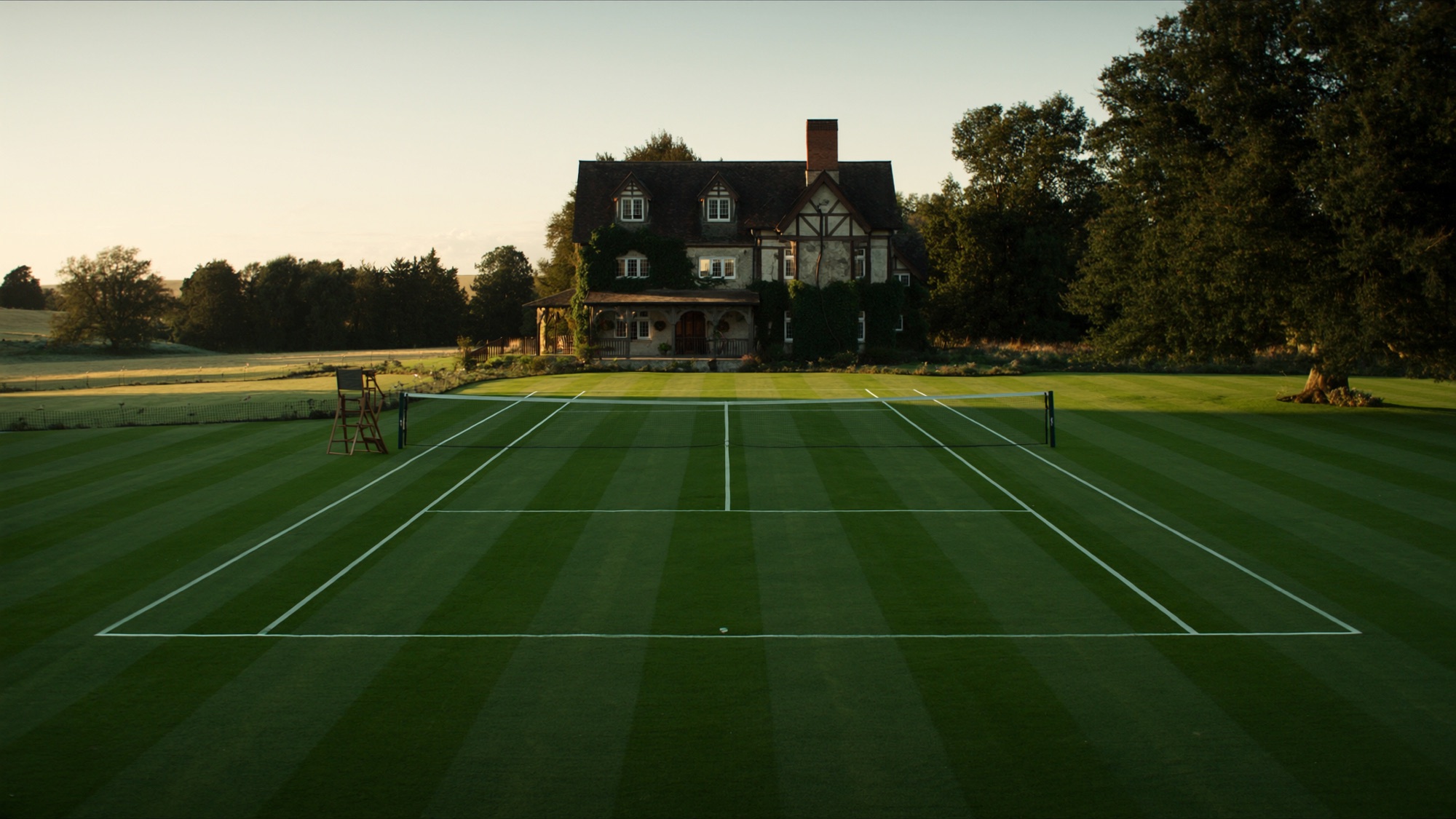
The All England Lawn Tennis and Croquet Club admits roughly 375 full and life members. To be considered, an applicant needs letters of support from four existing full members, two of whom must have known him or her for at least three years. The name then joins a candidates’ list, where it may sit for a very long time. Winning the tournament is a shortcut: champions are invited to become members.
That is not a description of a sporting body. It is a description of a club — a private company limited by guarantee, founded on 23 July 1868 as the All England Croquet Club, which happens to stage a fortnight in July watched by most of the planet. Wimbledon is not a tournament with a club attached. It is a club with a tournament attached.
Three of the four majors work something like this. One does not.
The Championships Are a Members’ Club’s Annual Event
The mechanics at Wimbledon are unusually explicit about who is inside and who is not. Full and life members hold a dedicated seat on Centre Court for the duration of The Championships. Beneath them sits the debenture system, first issued in 1920 and reissued in five-year tranches ever since: a debenture buys a pair of tickets for every day of the tournament across those five years, and funds the capital works that keep the grounds ahead of everyone else’s. Debenture holders are the only ticket holders at Wimbledon legally permitted to on-sell to third parties. The instruments now trade on the London Stock Exchange.
Everyone else queues, or enters a ballot that has run since 1924 and in recent years has been oversubscribed several times over.
The governance is equally particular. Since 1 August 2011 the club has held its Championships assets in a wholly owned subsidiary, and the Championships themselves are run by a committee of twelve club members and seven nominees of the Lawn Tennis Association. Even the colours are a club artefact: dark green and purple were adopted in 1909, after the club discovered its previous scheme was nearly identical to that of the Royal Marines.
None of this is presented as exclusivity. It is simply how a members’ club administers its own property. The billion-person broadcast audience is a consequence, not a purpose.
Paris Is a Federation Standing on Municipal Land
Roland-Garros is often filed alongside Wimbledon as the other old-world major, which is a category error worth correcting.
The French Championships began in 1891 as a closed event, restricted to members of French clubs, and moved between the Île de Puteaux, the Racing Club de France in the Bois de Boulogne and the Tennis Club de Paris. Then France won the Davis Cup in America in 1927 and needed somewhere to defend it. The president of Stade Français offered three hectares at the Porte d’Auteuil on a single condition: the ground be named for Roland Garros, a club member and the aviator who first crossed the Mediterranean by air. The stadium went up in roughly eight months and opened in 1928.
So the site was born of a private club’s gift. What sits on it now is not a club. The Fédération Française de Tennis — founded in 1920, renamed in 1976 — is the national governing body, an elected federation of affiliated clubs and licence-holders. Its headquarters are at the stadium. The land itself is recorded as belonging to the Paris administration; the FFT is the tenant.
That is a third structure entirely: not a members’ club, not a public parks authority, but a federation operating a municipal site under long tenure. It carries the manners of a club without the deed of one.
Melbourne Ran the Same Experiment Forty Years Ago
The Australian Open is organised by Tennis Australia at Melbourne Park, a facility owned by the Victorian government and managed by the Melbourne & Olympic Parks Trust, a statutory authority. It is, in ownership terms, public.
It was not always. From 1972 to 1987 the tournament sat permanently at the Kooyong Lawn Tennis Club, a private members’ club in the eastern suburbs whose stadium was built in 1927 and which still owns it. After the 1983 edition the International Tennis Federation pressed the Australian association to find a new site; Kooyong could not carry an event of that size. The tournament moved to the purpose-built Flinders Park, later renamed Melbourne Park, in 1988.
The result was immediate. Attendance rose by roughly ninety per cent in the first year at the new site. A private club had been the ceiling; removing it removed the ceiling.
Kooyong is still there, still private, still hosting its own invitational in January while the thing it used to own plays three miles away to crowds it could never have held. It is the cleanest available illustration of what a club gives up when it hands a major to a public facility, and what it gets back.
The American Version Started in a Casino and Ended in a Park
The US National Championships were first held in August 1881 at the Newport Casino in Rhode Island — a private social and sporting club, now the International Tennis Hall of Fame — and stayed there through 1914. The women’s championship began in 1887 at the Philadelphia Cricket Club, another private club, and remained there until 1921.
In 1915 the men’s singles moved to the West Side Tennis Club in Forest Hills, Queens. The club had been founded in 1892 by thirteen members renting ground off Central Park West, had relocated twice, and had settled in Forest Hills in 1912. By 1923 the tournament’s success had produced a 14,000-seat horseshoe stadium that still stands. The championships were played there in 1915–1920 and again from 1924 to 1977: grass until 1974, then clay for the final three editions.
For sixty-odd years, in other words, the American major was exactly what the other three were. A private club’s event.
Then it stopped.
The Man Who Saw It From an Aeroplane
In January 1977, W. E. “Slew” Hester — an independent oilman from Jackson, Mississippi, and president of the USTA in 1977–78 — was descending into LaGuardia when he looked out of the window at Flushing Meadows–Corona Park and saw the abandoned Singer Bowl, left over from the 1964 World’s Fair. He decided the US Open would be played there.
The eastern tennis establishment was unconvinced. The West Side Tennis Club opposed the move, as did a number of players. Hester went to New York City anyway and proposed leasing municipal parkland and building a public tennis centre on it, ready by August 1978 — a nineteen-month timeline for a facility that did not exist.
“If it’s done on time, it will be the USTA National Tennis Center. If not, they’ll call it the ‘Slew Hester Memorial.’”
— W. E. “Slew” Hester, quoted in Tennis Majors
It was done on time, at a cost reported at around $9–10 million and delivered by brute overtime. Hester’s instruction to the contractors, as he later recounted it, was: “Work night and day, get the job done, and send the bill. We couldn’t afford to do anything else because we didn’t have any other place to play.” Björn Borg opened the new stadium on 29 August 1978 against Bob Hewitt and afterwards said he supposed that at seventy-five he would look back and remember being the first man to play in it.
The 1978 tournament was the first US Open on hard courts. It drew 275,300 people. Walking the half-finished grounds shortly before it opened, Hester told a reporter: “This is just the beginning, boy — by 1979, the US Open is going to be more beautiful than Wimbledon.”
He was wrong about beautiful. He was right about everything else.
What Was Actually Traded
The Forest Hills departure is usually explained as a capacity problem, and capacity was the trigger. But a private club has only two responses to a tenant that has outgrown it: expand, or let it go. The West Side Tennis Club was a residential-scale club in a landmarked garden suburb. It could not have built Flushing Meadows even if its membership had wanted to, and there is no evidence its membership wanted to.
What the USTA chose instead was structural, not logistical. It moved its championship onto city parkland under lease, put the surface on the same hard courts American club players actually used, opened the site to public play for fifty weeks of the year, and built an event whose economics depend on volume rather than on scarcity. Night sessions followed. Television followed. Noise, aircraft, food halls, and a crowd that behaves like a crowd rather than like a gallery all followed.
That is not a side effect of the venue. It is the venue’s thesis. Wimbledon’s members do not need the tournament to be large; they need it to be theirs. The USTA needed it to be large, because large was the only asset it had left after it gave up being a club.
The Scarcity Did Not Disappear. It Moved.
Here is the part the democratisation story leaves out.
Nothing about Flushing Meadows abolished exclusive access to the US Open. It relocated it. The scarcity that used to live in a membership roll now lives in the suite tiers of Arthur Ashe Stadium, in the card-programme allocations that release the best seats to a few thousand cardholders, in the corporate hospitality inventory, and in the private clubs of Westchester, Long Island, and Connecticut that fill for the fortnight with people who came for the tennis and stayed for the dinner. Wimbledon puts its hierarchy on the deed, where you can read it. New York puts it on the ticket, where you cannot.
Both systems produce the same room. Only one of them admits it.
The US Open sold private-club scarcity for scale and got, in return, the loudest and richest tournament in the sport. It is the correct trade, and it is why the fortnight in Queens is the only major that feels like the country it is played in. But access was never abolished in 1978. It was simply moved off the deed and onto the ticket — and a ticket, unlike a membership, can be bought by anyone who knows where to look.