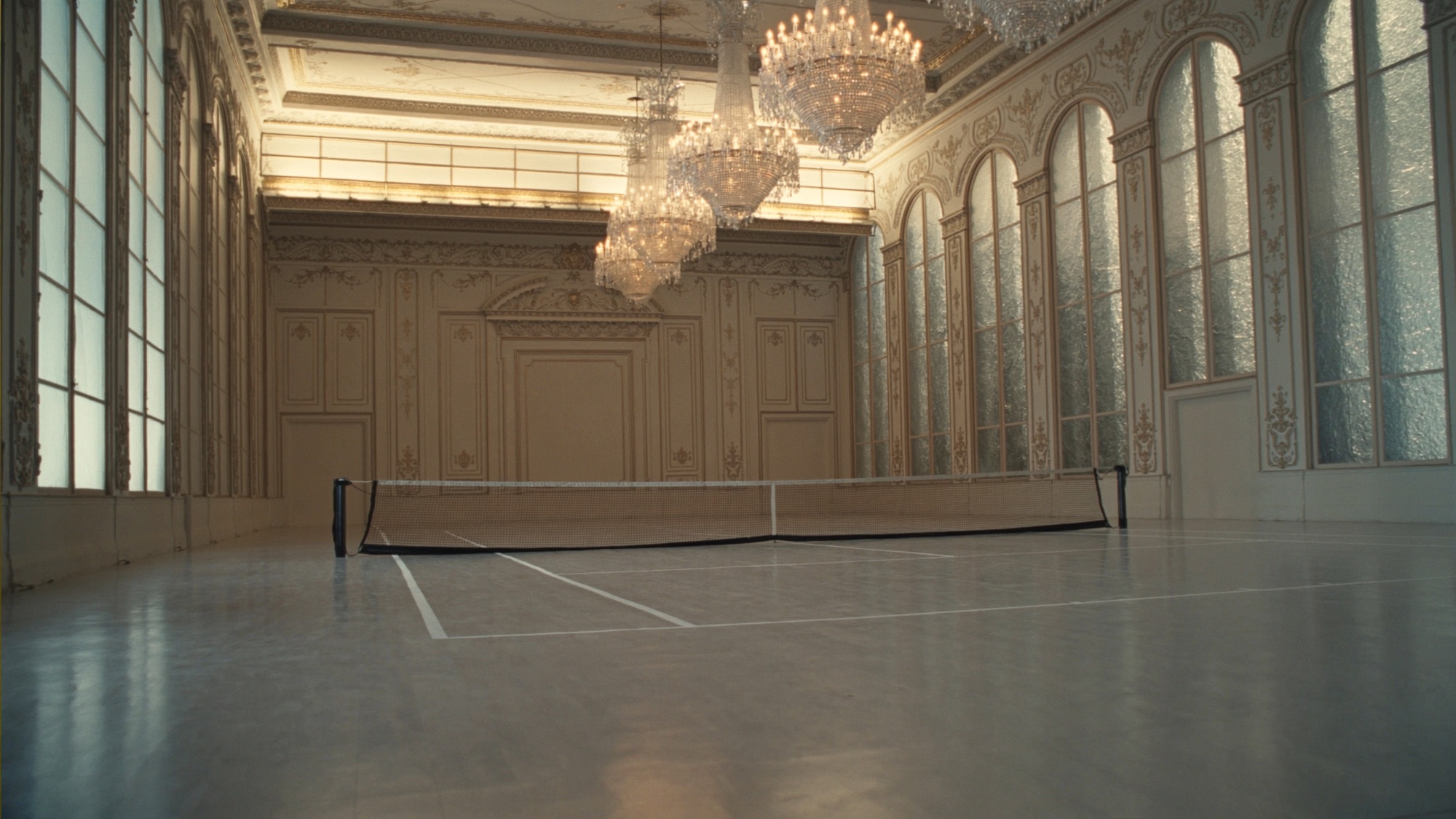
The Waldorf Astoria’s Grand Ballroom has held a Met Gala, a sitting president’s inaugural ball, and — as of August 27 — a tennis court. We covered the mechanics of that: a full-size hard court laid across the landmarked room for one night, Ben Shelton and Tommy Paul and Leylah Fernandez and Maria Sakkari playing beneath the chandeliers, the whole thing timed to US Open Fan Week and built, we argued, to launch a new Waldorf Astoria Racquet Club rather than to sell a single night’s tickets.
What we did not say is that the format itself is old. Tennis has been played on hockey ice, on a helipad, on a glacier, and on the wing of a moving biplane. Someone has been putting a net somewhere it does not belong for a full century, and nearly every time, a brand was standing behind the net holding the bill.
The Stunt Predates the Sponsor
The first documented version of this genre has nothing to do with luxury marketing. In 1925, the wing-walker Gladys Roy and a partner named Ivan Unger played a tennis match on the upper wing of a biplane in flight over Los Angeles — a barnstorming stunt, not a brand activation, staged purely because Roy’s living depended on being more dangerous and more photographed than the next daredevil. There was no ballroom, no chandeliers, no hospitality package. There was a plane, a net, and the certainty that a photograph of it would travel.
That is worth sitting with before getting to the glamorous version. The instinct to put tennis somewhere it should not survive is not a twenty-first-century invention of luxury hotels and apparel brands. It is a century-old attention mechanism. What changed is who pays for it and why.
The Pro Circuit Did It Out of Necessity, Not Novelty
Long before anyone thought to stage tennis as spectacle, the early professional game did it because it had no choice. Amateur tennis owned the prestige venues — Wimbledon, Forest Hills — and would not let professionals near them. So the pros barnstormed, and Madison Square Garden became their base of operations by default.
Bill Tilden turned professional and made his pro debut there on February 18, 1931, beating the Czech player Karel Kozeluh in front of 13,000 fans. Three years later, on January 10, 1934, the Garden hosted Tilden against a 23-year-old Ellsworth Vines in front of 14,637 spectators — reportedly the largest crowd to watch a tennis match anywhere to that point — grossing over $30,000 with courtside seats at $5. Don Budge made his own pro debut against Vines there on January 3, 1939; Jack Kramer made his against Bobby Riggs on December 26, 1947, during a blizzard.
By the time the pro tour reached Rod Laver’s generation in the 1960s, the arrangement at the Garden had become literal rather than metaphorical: when the New York Rangers had the ice down, the tour laid a canvas court directly on top of it. Laver later recalled being “numb to the knees” by the end of a match, and warned against running off the playing surface, where a player would find himself “slipping and sliding all over” on exposed ice. On the same circuit, temporary courts were laid inside Spanish bullrings by crews who — in Laver’s account — had no real method for the job, leaving patches of bare ground that better players learned to aim for.
None of this was theatre. It was a sport with nowhere else to play, making do with whatever floor a promoter could rent for a night. The theatrical version came later, once someone worked out that “nowhere else to play” could be sold as a feature rather than hidden as a limitation.
The Helipad Made the Genre Legible
The pivot point is February 22, 2005: Roger Federer and Andre Agassi hitting for twenty minutes on the helipad of Dubai’s Burj Al Arab, 210 metres above the Arabian Gulf, on an artificial grass surface laid over the pad for the occasion. It was staged to promote that year’s Dubai Duty Free Tennis Championships, and it worked far beyond the tournament it was meant to sell — the photographs of two of the sport’s biggest names hitting balls off the edge of a hotel roof became, and largely remain, the reference image for the entire genre.
It is worth noting what happened to that helipad afterward. It has since hosted a car-racing stunt, a boxing exhibition, and the launch point for a record kitesurfing jump. The tennis match did not just borrow the venue’s altitude for an afternoon — it taught the hotel that its roof was a stage, and the hotel kept booking it.
The pattern repeated with variations rather than repetitions of the original. The popular telling often compresses Federer’s later exhibitions in Doha into a second helipad match; the record does not support that. What actually happened, on January 4, 2009, was Federer and Rafael Nadal playing a volleys-only exhibition aboard a dhow in Doha Bay, staged to launch that year’s ATP World Tour season and tied to the Qatar Open. Five years after that, in July 2014, Federer played a different exhibition against skier Lindsey Vonn on a court built on a glacier in the Swiss Alps, sponsored by the chocolatier Lindt, after Vonn challenged him to a match over social media. And in September 2024, Novak Djokovic hit balls with the actor Wang Yibo on a court built at Juyongguan, a preserved pass of the Great Wall northwest of Beijing, as the centrepiece of Lacoste’s “Play Big” campaign.
Boat, glacier, national monument — different sponsor each time, different tennis star, same mechanism. The venue is chosen for how implausible it looks in a sixteen-second video, and the athlete is chosen for how much credibility they lend the brand standing just off-camera.
The venue changes. The transaction does not. A recognisable player, an unrecognisable location, and a brand that gets to stand next to both for the length of one photograph.
The Ballroom Is a Return, Not a Departure
Here is the detail the genre usually obscures: tennis indoors, under a roof, inside a building built for something else entirely, is not a novelty at all. It is closer to the original format of the game.
Real tennis — the direct ancestor of the lawn game, and the source of its scoring — was played indoors from the start, inside enclosed courts built into palaces and grand houses across France and England. Henry VIII had a court built at Hampton Court Palace in 1530; James V of Scotland had one built at Falkland Palace around the same decade, and it remains playable today. By 1596, a Papal Legate reported roughly 250 such courts in Paris alone. Lawn tennis — grass, sunlight, a garden party — is the historical newcomer. The version played inside a room built for a king is the original.
Which makes the Waldorf’s ballroom less of a stunt than the Burj Al Arab helipad ever was, whatever the chandeliers suggest. A hard court under a three-storey ceiling is not tennis going somewhere it has never been. It is tennis going back.
What every one of these events has actually sold — the helipad, the dhow, the glacier, the Great Wall, and now the ballroom — is not a match. Scorelines from exhibition tennis are forgotten within the week. What survives is the photograph of somewhere the sport does not normally go, and the memory of who was standing close enough to be in the frame. The Waldorf’s version is more honest than most of its predecessors, because it is not pretending the court is the point. It is telling you, plainly, that the point is the room, and that a membership is the way back in after the net comes down.