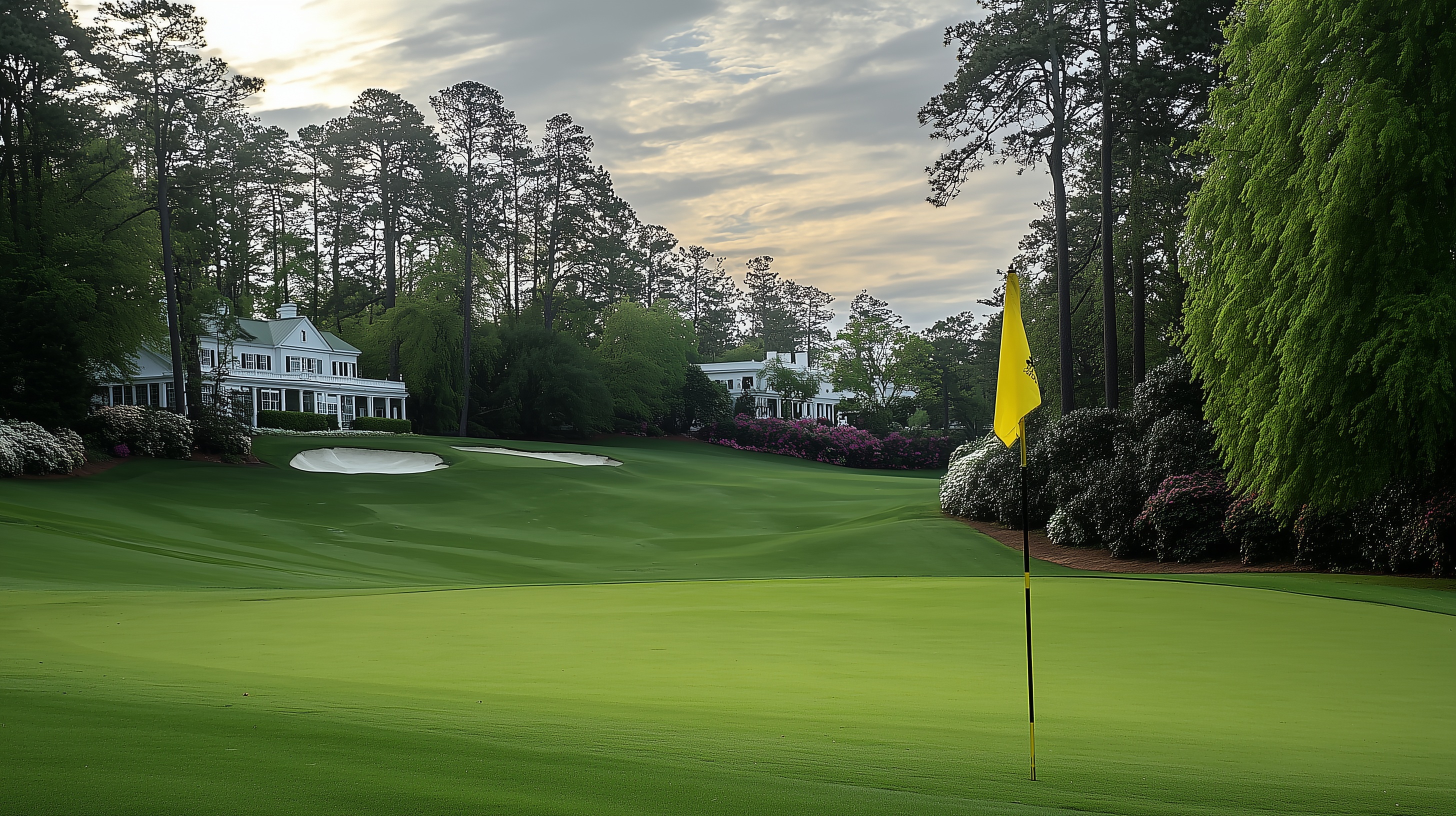
A Course Built for the Pacific
When the Los Angeles Athletic Club purchased 300 acres in the Palisades del Rey canyon for $264,500 in the mid-1920s, the brief to architect George C. Thomas Jr. was straightforward: build something worthy of the setting. Thomas, who had already completed Bel-Air and Los Angeles Country Club’s North Course, worked alongside construction engineer William P. Bell and opened the course on June 24, 1927. Alister MacKenzie, who would later design Augusta National, visited and called it “as nearly perfect as a man could make it.” Ninety-nine years on, the assessment holds.
The site itself does much of the work. A natural barranca—a steep-sided Southern California ravine, dry most of the year and carrying water through winter rains—cuts through the eastern portions of the property and Thomas incorporated it on roughly seven holes rather than routing around it. On the 11th, the ravine crosses roughly 160 yards short of the green. On the 4th and 7th it frames approach corridors. Thomas grassed the worst of it in kikuyu, but the barranca still dictates ball placement off the tee in ways that few natural features on any American course can match.
Kikuyu, Architecture, and What Makes the Course Play Hard
Riviera is the Tour’s most prominent kikuyu venue. The grass (Pennisetum clandestinum) covers fairways, surrounds, and rough, and it behaves differently in each context. In the short stuff it produces clean, slightly teed-up lies—the “Riviera tee.” In the rough it grabs the hosel, twists the clubface, and alternately flyers or buries the ball without visual warning. Shallow-swinging players who pick the ball—Adam Scott is the stock example—consistently outperform steep-attackers. No other surface on the PGA Tour schedule produces comparable dispersion statistics with the same club from 100 yards.
Thomas’s routing gives the grass somewhere to matter. Five holes stand apart architecturally. The par-3 4th—measuring around 236 yards, wind-exposed, with a severe right-to-left green slope and a deep front bunker—was the hole Ben Hogan called “the greatest par-3 in America.” The par-3 6th features a bunker positioned in the center of the putting surface, splitting the green and turning a routine approach into a study in placement. The drivable par-4 10th runs roughly 315 yards; Jack Nicklaus called it one of the ten best 10th holes in major championship golf. The par-3 16th sits at the foot of the canyon with a small green ringed entirely by steep, deep bunkers. And the par-5 17th closes the back nine at around 590 yards against the prevailing wind. The course plays to par 71 at 7,383 yards from the championship tees—lengthened for the 2026 Genesis Invitational setup.
Hogan’s Alley
No player is more associated with Riviera than Ben Hogan, and the association was earned in an 18-month stretch that has no modern equivalent. Hogan won the 1947 Los Angeles Open here with a then-record 280, returned to win the 1948 LA Open in defense of the title, and then won the 1948 U.S. Open held at Riviera four months later. Three victories at one course in 18 months prompted sportswriters to name it Hogan’s Alley, and the nickname has never left. The 1948 U.S. Open was the only major championship held at Riviera until the PGA Championship returned in 1983 (Hal Sutton over Nicklaus) and 1995 (Steve Elkington, in a playoff against Colin Montgomerie that is still cited in discussions of the best ball-striking final rounds in major history). The 2017 U.S. Amateur and the 2026 U.S. Women’s Open round out the major-championship résumé.
The Genesis Invitational and the Course Today
The Los Angeles Open first came to Riviera in 1929 and has returned almost every year since, making it among the longest-running venue-tournament relationships in professional golf. The event is now the Genesis Invitational, promoted to Signature Event status on the PGA Tour and hosted by Tiger Woods’s TGR Foundation. The Signature designation restricts the field to approximately 70 players—no opposite-field dilution—and the purse has scaled accordingly. The result is a February week that functions as an informal season opener for the world’s best players before Augusta. Scoring has trended upward with the lengthened setup: the kikuyu rough, the barranca, and the coastal winds off the Pacific make any total in the mid-60s meaningful here in a way it would not be at a resort-style layout.
LA 2028: What the Olympics Bring to Riviera
Golf returns to the Olympics for the fourth time in Los Angeles, and for the first time, the program includes a mixed team event. The International Golf Federation confirmed Riviera as the 2028 venue, and the schedule runs across three separate competitions within the broader Games window of July 14—30.
Men’s individual stroke play runs July 19—22 over 72 holes with no cut, a 60-player field, and a sudden-death playoff for ties. Women’s individual stroke play follows on July 26—29 under the same format. Between them, on July 23—24, the mixed team event debuts: 36 holes total, with Round 1 played as 18-hole four-ball (best ball) and Round 2 as 18-hole foursomes (alternate shot). Each country fields one mixed team, comprising one man and one woman who have already qualified for their respective individual events. The four-player-per-country cap applies to countries with multiple players ranked in the world top 15; otherwise the limit is two per country. No cut is made in any event.
The mixed team format is the headline structural change from Tokyo 2020 and Paris 2024, which offered only individual stroke play. Four-ball and foursomes in a single 36-hole knockout-style format places a premium on partnership—course management decisions, line selection on foursomes shots—that individual events simply cannot surface. Riviera’s tight corridors and kikuyu rough will make the foursomes round in particular worth watching.
Access: Private Club, Public Games
Riviera operates as a strictly private membership club. Playing the course requires sponsorship and accompaniment by a member—there is no resort tee sheet, no public ballot, no single-day guest fee that can be arranged independently. The club does not publish initiation or dues figures. For most golfers, the course exists only on television or in recollection of a rare member invitation.
The 2028 Olympics represent the practical exception. Olympic golf tickets are sold through the LA28 public ticketing process, meaning spectating access to Riviera during competition week will be available to anyone who secures a grounds pass. Specific pricing and on-sale dates have not been announced as of mid-2026, but the ticket pipeline follows the same LA28 infrastructure used for all other Olympic venues. It will be, for many golfers, the only time they stand inside the ropes at the course. The difference between watching a Genesis Invitational broadcast and standing beside the 6th green during an Olympic foursomes round is worth noting.
Why the Venue Selection Matters
The IOC and IGF could have specified a new or semi-public venue for 2028. They did not. Riviera was selected on the same basis as Rio’s Reserva de Marapendã or Kasumigaseki Country Club in Tokyo: course quality and tournament infrastructure already proven at the highest professional level. What it communicates is that Olympic golf has decided its standard of venue is the same as its standard for major championships—not a purpose-built facility, but one of the courses that defines what the game looks like at its most demanding. For a club founded nearly a century ago in a Pacific canyon, with a bunker in the middle of a green and a ravine running through the heart of the routing, that is a straightforward endorsement.
Keep reading
- The 12 Most Exclusive Private Clubs in America
- Why Business Still Gets Done on the Golf Course
- Can You Play Private Golf Courses Without Being a Member?
One network, dozens of destinations. LXV membership reaches clubs that share Riviera’s standard—strictly private, architecturally serious, built for golfers who know the difference — alongside reciprocal access to the world’s most exclusive private clubs. Apply for membership →