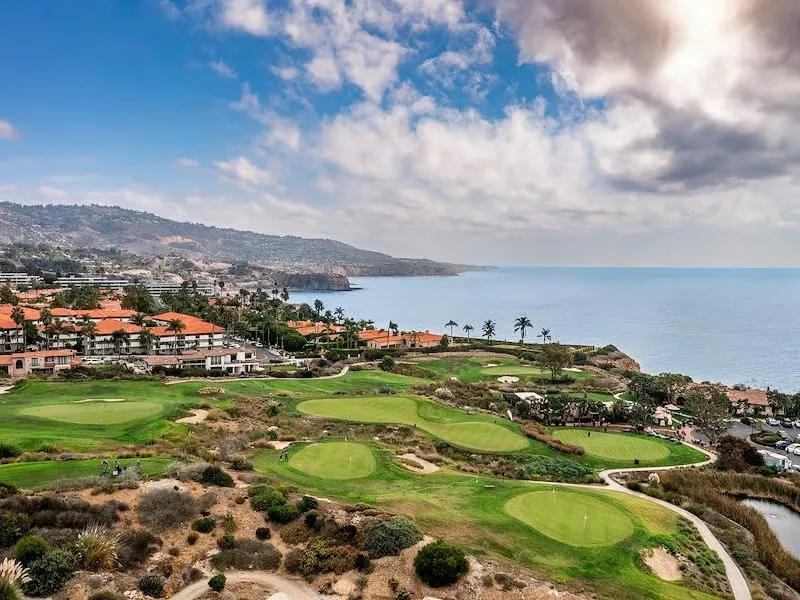
California has a claim that no other state can credibly contest: the greatest concentration of resort golf on the continent. Partly geography—coastal bluffs, mountain valleys, canyon preserves, and a climate that keeps turf playable year-round—and partly a century of sustained investment by designers who treated the terrain as raw material rather than obstacle. Robert Trent Jones Sr. walked the Del Monte Forest in the early 1960s and routed Spyglass Hill through it. George C. Thomas Jr. called the course he built at Ojai in 1923 the finest of his career, ranking it above Riviera. Tom Fazio has three distinct entries across the state. That design lineage is what separates California from every competitor.
What follows is a shortlist—eight properties that hold up against serious scrutiny, organized not by magazine ranking but by what actually matters to a member traveling on a tight schedule: the quality of the course, the integrity of the setting, and whether access is realistic without a local connection.
Pebble Beach Resorts
The Monterey Peninsula is the only place in American golf where a single trip yields five courses worth flying across the country for, each with a different architectural DNA. Pebble Beach Resorts holds the keys to three of them: Pebble Beach Golf Links, Spyglass Hill, and The Links at Spanish Bay.
Pebble Beach Golf Links was laid out in 1919 by Jack Neville and Douglas Grant—both amateur champions, neither a professional architect—along the clifftops above Stillwater Cove. The routing hugs the Pacific for several consecutive holes through the middle of the card, with the par-3 7th and the par-5 18th among the most replicated templates in the game. It has hosted six U.S. Opens; a seventh is scheduled for 2027. It plays public, which makes it unusual among courses of its stature.
Spyglass Hill, designed by Robert Trent Jones Sr. and opened in 1966, runs from exposed Pacific views on the first five holes into the shadows of Del Monte Forest for the back thirteen. Jones named every hole after a character or location from Treasure Island—the Stevenson novel was set nearby—and called hole 4, “Blind Pew,” the finest par-4 he ever designed. The contrast between the links-style opening and the tree-lined parkland finish gives it a structural range that the Golf Links, for all its fame, does not have.
Spanish Bay, designed by Robert Trent Jones Jr., Tom Watson, and Sandy Tatum and opened in 1987 on the Monterey coast, is currently closed for a full redesign by Gil Hanse; it is scheduled to reopen in April 2027 at approximately 7,115 yards. Plan accordingly.
The two private courses at Monterey Peninsula Country Club—the Dunes, designed by Charles B. Macdonald and Seth Raynor in 1926, and the Shore, redesigned by Mike Strantz in 2004 along the most exposed stretch of rocky Pebble Beach coastline—require a member introduction and are not accessible through the resort. They rotate into the AT&T Pebble Beach Pro-Am each year, which is when most people see them on television and want to play them. Access requires a sponsor.
The Resort at Pelican Hill
The Resort at Pelican Hill sits on the clifftops above Newport Coast, roughly an hour south of Los Angeles, and operates two 18-hole Tom Fazio courses: Ocean North (par 71, 6,945 yards) and Ocean South (par 70, 6,580 yards). Both courses were ranked in Golf Digest’s 2025–26 list of America’s 100 Greatest Public Courses—Ocean North at No. 54, Ocean South at No. 60.
Ocean South opened first, in 1991, followed by Ocean North in 1993. The stretch of consecutive clifftop holes on Ocean South—the 11th through 13th—runs directly alongside the bluffs above Crystal Cove State Beach, with the Pacific several hundred feet below. The courses are open to the public, though resort guests receive priority tee time access. For a regulation Fazio design on the Southern California coast without a private-club introduction, there is no better option.
Ojai Valley Inn
Ojai Valley Inn’s course was commissioned in 1923 by glass industrialist Edward Libbey and designed by George C. Thomas Jr. and Billy Bell. Thomas, who also designed Riviera Country Club and the Los Angeles Country Club North course, said Ojai was “far and away above the best” of all his designs. He ranked it above both of those clubs—a judgment that surprises people who know his other work.
The 18-hole, par-70 layout (6,305 yards) runs through a coastal valley framed by the Topa Topa Mountains, with fairways lined by ancient oaks and deep barrancas—ravines that are very much in play. The course operates at 70.7 rating and 125 slope from the back tees. After World War II, two of Thomas’s original holes were lost; in 1999, Carter Morrish restored them—working from a surviving scorecard and a single photograph—as the current 16th and 17th. Hole 2, “Devil’s Cauldron,” a 358-yard downhill par-4, was named to Golf Magazine’s 500 Greatest Golf Holes. The course is open to resort guests and the public.
CordeValle
CordeValle occupies a broad valley at the base of the Santa Cruz Mountains about 35 miles south of San Jose—not a location that announces itself, which is part of the point. The course was designed by Robert Trent Jones Jr., who has described it as his finest work. He routed the 18 holes around dozens of ancient oaks and sycamores, incorporating creek corridors, canyon edges, and open meadows across 150 feet of total elevation change. The course is fully walkable.
At 7,360 yards from the tips (slope 142, rating 75.0), it plays as a genuine test—it hosted the PGA Tour’s Frys.com Open from 2010 through 2013 and the U.S. Women’s Open in 2016. Golf Digest ranked it No. 52 on America’s 100 Greatest Public Courses in 2025–26, though the classification is slightly misleading: CordeValle is semi-private, operating through a Rosewood resort of bungalows and casitas on the property. Walk-on public access is not available. Members and resort guests only.
Terranea
Terranea sits on 102 oceanfront acres on the Palos Verdes Peninsula in Rancho Palos Verdes, roughly 25 miles south of downtown Los Angeles. Its golf offering is The Links at Terranea, a nine-hole par-3 course (par 27, 1,239 yards) designed by Todd Eckenrode of Origins Golf Design. Individual holes range from 104 to 173 yards, and every tee shot carries a Pacific Ocean view, with Catalina Island on the horizon on clear days.
This is not a destination golf course in the traditional sense—it does not fill a golf trip the way Pebble or CordeValle does. It is a resort amenity that happens to have unusually good bones: clifftop terrain, consistent ocean wind, and short-game conditions that reward precision over power. Tee times are open to resort guests and available to the public through standard booking platforms. It is the right course for the evening before a flight or the morning after one.
The Ritz-Carlton Half Moon Bay
The Ritz-Carlton Half Moon Bay operates two 18-hole courses under the Half Moon Bay Golf Links banner on the San Mateo coast, about 25 miles south of San Francisco. Both are open to the public—no hotel stay required.
The Old Course was designed by Arnold Palmer and Frank Duane and opened in 1973, routed primarily through residential corridors with a finishing stretch along clifftop bluffs above the Pacific. The Ocean Course, designed by Arthur Hills and Spencer Holt and opened in 1997, runs entirely along the bluffs—no housing on the course at all—in a links-style layout with firm conditions and consistent coastal wind. The par-3 17th on the Ocean Course, set on a blufftop above the water, draws frequent comparisons to the 7th at Pebble Beach. The proximity to San Francisco makes both courses accessible as day trips from the city.
Alisal Ranch
Alisal Ranch operates as a working cattle ranch in the Santa Ynez Valley, near Solvang, with 10,000 acres under management and two golf courses that share almost nothing in character.
The Ranch Course, designed by William F. Bell Jr. and opened in 1956, is built around a central barranca and shaded by oaks, pines, sycamores, and eucalyptus. At 6,542 yards (par 72), it plays as a resort course—manageable length, authentic ranch terrain—and is reserved exclusively for Alisal guests and club members. The River Course, designed by Jack Daray Jr. and Stephen Halsey and opened in 1992, runs along the Santa Ynez River at 6,830 yards (par 72) with live oaks and native sycamores lining the fairways and the Santa Ynez Mountains as the horizon. The River Course is open to the public. Alisal’s primary draw is the combination: two rounds, two very different courses, within a valley setting that has no equivalent in California resort golf.
Fairmont Grand Del Mar
Fairmont Grand Del Mar’s course, The Grand Golf Club, is the only Tom Fazio design in San Diego. Originally opened in 1999 as a daily-fee public course called Meadows Del Mar, it was purchased in 2003 and extensively renovated by Fazio before reopening in 2006 as a private club. The 18-hole, par-72 layout plays to 7,160 yards from the championship tees (slope 139–145) through Los Peñasquitos Canyon Preserve, with 300 feet of elevation change, canyon walls on multiple holes, and a closing 18th that finishes over a stream to a waterfall carry. The clubhouse runs 50,000 square feet with nearly seven acres of practice facilities and traditional forecaddie service. Access is restricted to members and Fairmont Grand Del Mar hotel guests.
Keep reading
- How to Play Pebble Beach: Tee Times, Cost, and Access in 2026
- The Golf Courses Worth Building a Life Around
- The Best Golf Resorts in Los Cabos and Coastal Mexico
One network, dozens of destinations. These California properties are part of what LXV members access through a single network — alongside reciprocal access to the world’s most exclusive private clubs. Apply for membership →